

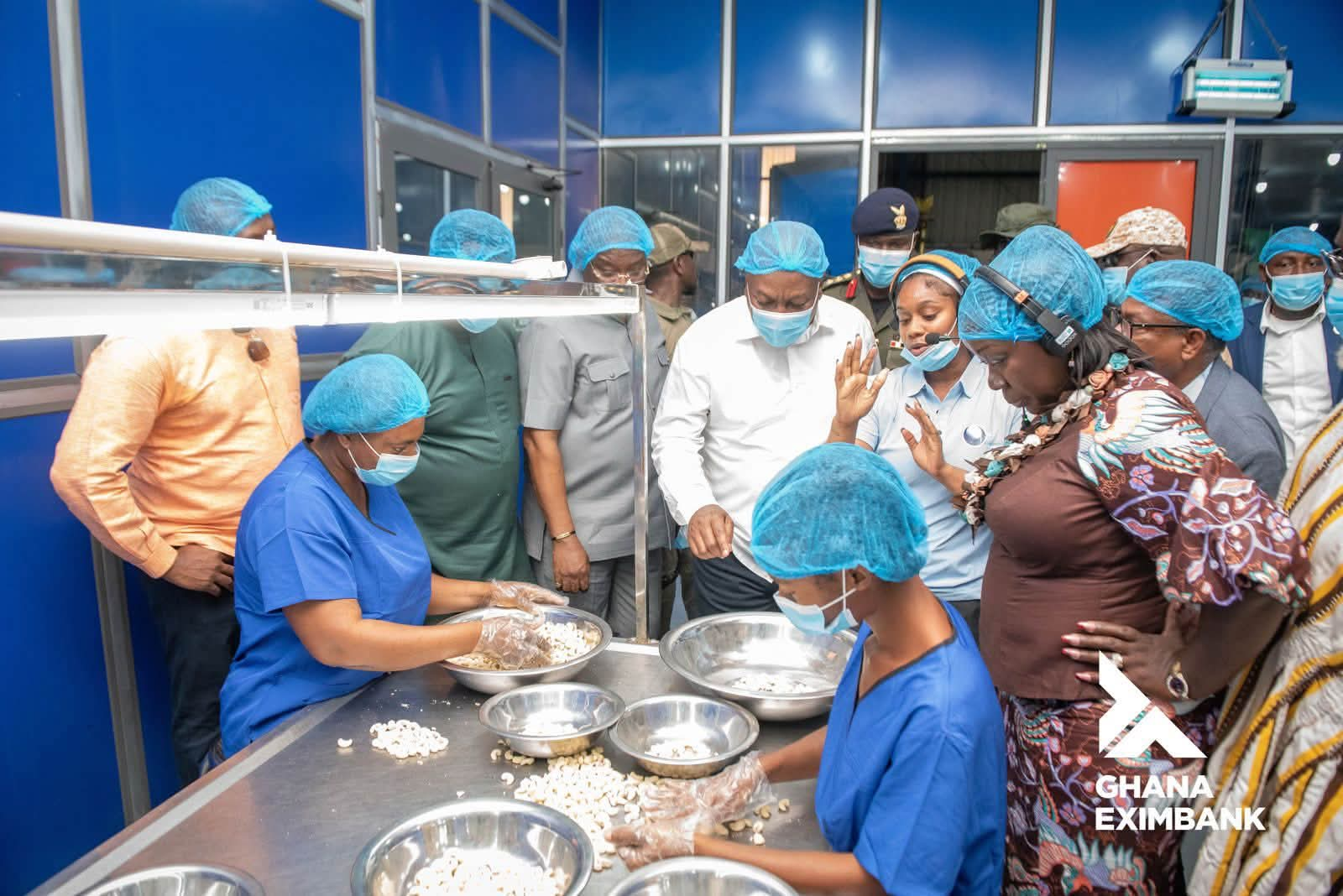
A newly established cashew processing factory is expected to create over 1,500 direct jobs and 3,000 indirect jobs in the value chain.
Valued at GH¢148.4 million, the factory was commissioned by President Mahama at Tuobodom in the Techiman North Municipality of the Bono East Region on Monday, November 16, 2026.
Nadkansco Processing Limited owns the processing facility, which can process 100 tonnes of cashew nuts daily and an estimated 30,000 tonnes annually.
The inauguration forms part of measures to stop the export of unprocessed cashew nuts and promote local value addition.
The Ghana Export-Import Bank (EXIM Bank) financed the establishment of the factory. The financing covers the acquisition of modern automated processing equipment, working capital and workforce training. It is also fulfilment of a campaign promise by President Mahama to establish cashew processing factories in the Bono and Ahafo areas.
President Mahama said the government was committed to transforming the country’s economic landscape through investments in agriculture and agro-processing.
According to him, agriculture has been identified as a major component of the US$10 billion, eight-pillar New Economy policy; hence, these initiatives aim to ensure job creation and economic development.
To protect the local processing industry through a constant supply of raw cashew nuts, he announced plans to enforce a three-month ban on exporting the commodity in its raw form and a new levy. He said this will lead to a guarantee of a ready market for farmers.

“We are going to implement a policy that, when the season opens, for the first three months of the season, nobody will be allowed to export cashew nuts from Ghana until our local processors have bought enough. In addition, we intend to put a levy on any cashew that is exported, like Côte d’Ivoire is doing,” the President said.

According to the Chief Executive Officer of the EXIM Bank, Sylvester Mensah, “Ghana produced over 262,000 metric tonnes of raw cashew nuts last year, yet only about 17,000 metric tonnes were processed locally. With an installed annual processing capacity of 33,000 metric tonnes, this factory represents a significant step towards closing that gap.”
