

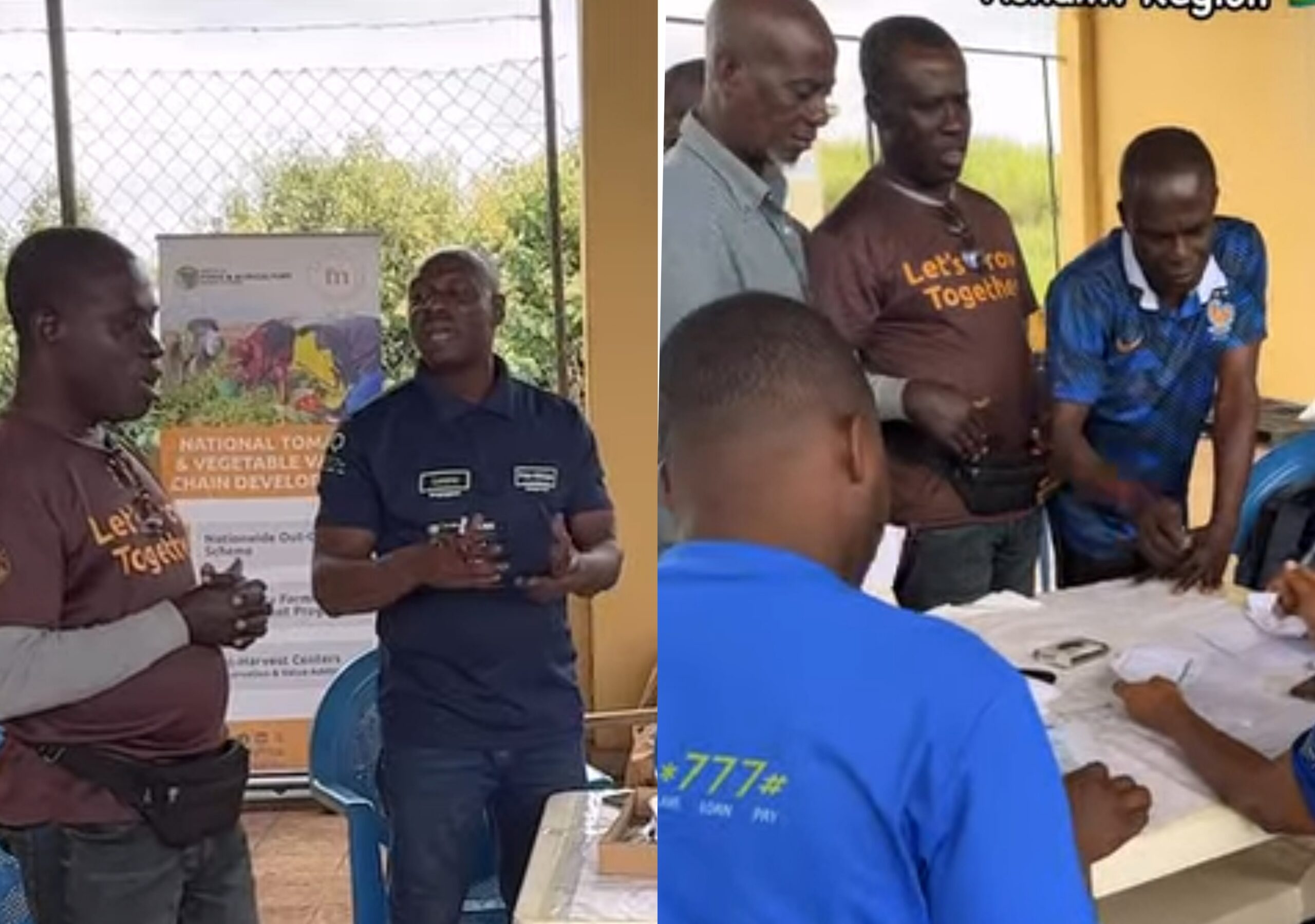
One after the other, tomato farmers in Akumadan in the Offinso North District of the Ashanti Region, took their turn to register for a financial support package that seeks to improve livelihoods and address post-harvest losses.
FarmMate Africa, an agricultural company in partnership with Pan African Savings & Loans, subsidiary of Ecobank, has brought renewed hope to the “farmers to overcome one of their biggest challenges: access to finance.”
Land preparation, inputs and labour are capital intensive becoming a major barrier to achieving their full production potential for many farmers.
“Through this partnership, farmers can access financial support of up to GH¢20,000 per acre to finance their tomato production,” FarmMate Africa says on its official Facebook page.
Nationwide Target To Cut Imports
Since its inception FarmMate Africa has been collaborating with financial institutions and the Ministry of Food and Agriculture (MoFA) to scale up tomato production across Ghana, in an ambitious drive aimed at reducing the country’s heavy reliance on imported fresh and processed tomatoes.
The company says it is mobilizing support systems that enable farmers to cultivate more than 40,000 acres of tomatoes nationwide annually, combining structured financing, guaranteed markets, and climate-smart agriculture practices to improve yields and quality.
Ghana continues to spend significantly on tomato imports, especially during the dry season when local production falls short of demand. According to recent report by researchers researchers at the Council for Scientific and Industrial Research (CSIR), the country spends $168 million annually on importing tomatoes to meet local demands. Despite being one of West Africa’s major agricultural producers, the country’s tomato value chain remains constrained by limited irrigation, post-harvest losses, and weak access to affordable credit.
FarmMate Africa is seeking to change this narrative by introducing a blended model that links farmers directly to finance and assured markets. Under the arrangement, farmers receive input support and production financing through partner financial institutions, while repayment is structured to occur only after harvest.
A key feature of the model is an offtake agreement, where FarmMate commits to purchasing the entire harvest from participating farmers. After harvest, loan deductions are made directly from the proceeds, with the remaining balance paid to farmers.
“And there’s more. Farmers only repay after harvest, while FarmMate has agreements in place to offtake their entire produce.”
“Once the loan is deducted from the proceeds, the balance goes directly to the farmer.”
According to the company, this approach reduces the risk burden on farmers, eliminates middlemen uncertainties, and ensures predictable income flows for smallholder producers.
FarmMate Africa says it is also promoting climate-smart farming techniques, including improved irrigation systems, resilient seed varieties, and modern agronomic practices aimed at increasing productivity per acre while reducing vulnerability to climate shocks.
“This is more than financing. It is about removing barriers, empowering farmers, improving productivity and creating a more sustainable path from farm to market,” the company says.
The initiative is positioned as part of a broader effort to strengthen Ghana’s food security agenda by improving domestic tomato supply, stabilising prices, and reducing import dependence.
If successfully scaled, the initiative has potential to significantly reshape Ghana’s tomato industry by linking production, financing, and guaranteed markets in a structured ecosystem designed to support farmers from planting to sale.
FarmMate Africa and its partners maintain that when farmers have the right financial and technical support, they are better positioned to produce at their best, turning agriculture into a more reliable and profitable livelihood.
“When farmers have the support they need, they can produce at their best.”
Farmmate Africa has a presence in tomato growing areas including Ada, Anloga, Wodze, Zebilla and Navrongo among many others.
