

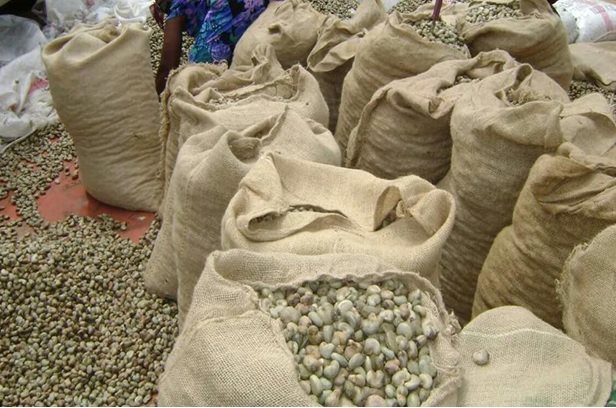
Ghana’s cashew sector is facing renewed concerns over price instability, weak local processing and the continued export of raw nuts, following a sharp decline in farm-gate prices in 2025.
Although Ghana produces hundreds of thousands of tonnes of cashew nuts annually, the country continues to capture only a small share of the value generated from the crop, as more than 94 percent of locally produced raw cashew nuts are exported or traded without being processed domestically.
A new independent study on Ghana’s cashew industry has revealed that the country processed only about 15,000 metric tonnes of raw cashew nuts in 2025, representing less than six percent of its estimated annual production of 262,000 metric tonnes.
The findings have renewed calls for urgent government intervention to transform the cashew industry from a largely raw-export business into a competitive agro-processing sector capable of creating jobs, generating tax revenue, stabilising markets for farmers and retaining more value within the country.
The report, Ghana Cashew Processing Sector and Roadmap for a Supportive Cashew Public Policy, was conducted by international agricultural economics consultancy Nitidae, with support from the Association of Cashew Processors of Ghana (ACPG), GIZ and the European Union Delegation to Ghana.
2025 price decline raises concerns
One of the major concerns highlighted by the study is the volatility of cashew prices and its impact on farming households.
In 2025, farm-gate prices reportedly started at about GH¢16 per kilogramme in January and rose to approximately GH¢20 per kilogramme in February. However, prices later declined sharply to around GH¢7 per kilogramme by May.
The significant drop has raised concerns about the vulnerability of farmers, particularly because many depend heavily on cashew sales as a major source of income.
The decline also reflects the risks associated with Ghana’s dependence on the export of raw cashew nuts. Without a strong local processing industry to provide an alternative and more structured market, farmers remain highly exposed to changes in international demand and fluctuations in the global raw-nut trade.
The price volatility was not limited to 2025. In 2023, farm-gate prices reportedly dropped from GH¢11 per kilogramme in March to GH¢2.80 per kilogramme in May.
The study noted that such sharp fluctuations create uncertainty for farmers and could discourage investment in the expansion and maintenance of cashew farms.
A stronger domestic processing industry, the report argued, could help create more stable and predictable markets for farmers while reducing the sector’s dependence on international buyers of raw nuts.
Ghana exports more raw cashews than it produces
Despite producing an estimated 262,000 tonnes of raw cashew nuts annually, Ghana exported approximately 444,000 tonnes of raw cashew nuts in 2025, mainly to Vietnam and India, the world’s two dominant cashew-processing countries.
The figures highlight a major paradox in Ghana’s cashew economy: the country exports significantly more raw cashew nuts than it produces.
According to Nitidae, the difference is largely explained by an estimated 165,000 tonnes of raw cashew nuts imported informally from Côte d’Ivoire, Mali and Burkina Faso and subsequently exported through Ghana’s Tema Port.
The study said Ghana’s relatively liberal raw cashew export regime, coupled with the absence of strong measures to promote domestic processing, has made the country an important trading route for raw cashew nuts while doing little to expand its own processing capacity.
As a result, Ghana participates significantly in the global cashew trade but captures only a small portion of the economic value generated through processing.
Jobs and revenue lost through raw exports
The consequences of limited local processing go beyond the export of an agricultural commodity.
According to the study, a modern cashew-processing factory with a capacity of 20,000 metric tonnes could employ at least 120 full-time workers and approximately 500 daily workers.
With Ghana’s current production levels, the report estimates that the country could potentially support more than 10 factories of a similar scale.
Such investments could create thousands of direct and indirect jobs across farming, transportation, logistics, packaging, engineering, manufacturing, finance and other related services.
Instead, much of the processing and associated economic activity takes place outside Ghana.
“Most of the added value is generated outside of Ghana,” the study observed, warning that the country’s continued focus on raw exports is limiting job creation and the development of businesses within the national economy.
The President of the Association of Cashew Processors of Ghana, Mr Antonio Manuel Caramelo Raposo, said the country was losing significant economic opportunities by exporting raw cashew nuts.
“Every tonne we export raw is a factory job, a tax cedi and a unit of foreign exchange we are choosing to send to Vietnam and India instead of keeping in Ghana,” he said.
He added that the study provides policymakers with a clear, data-driven roadmap for closing the gap between Ghana’s industrialisation ambitions and the investment conditions needed to achieve them.
High costs discourage investment
The study also identified high investment and operating costs as major obstacles to the growth of Ghana’s cashew-processing industry.
It estimated that establishing a modern 20,000-metric-tonne processing factory would cost approximately US$9.2 million in Ghana, compared with about US$5.3 million in Vietnam.
Ghana must prioritise local cashew processing to unlock jobs and boost export earnings – ACPG
The cost of setting up an equivalent processing facility in Ghana is therefore almost twice that of Vietnam.
Ghanaian processors also face high electricity costs, expensive imported machinery and production inputs, limited industrial support systems and high borrowing costs.
The report noted that interest rates for businesses in Ghana could be around 20 percent, compared with approximately nine percent in Vietnam.
These conditions significantly weaken the financial attractiveness of investing in Ghana’s cashew-processing industry and make it difficult for local processors to compete with their counterparts in major processing countries.
Production grows, but processing remains weak
Ghana has recorded consistent growth in cashew production since 2016, with the Bono and Bono East regions forming the heart of the country’s cashew belt.
The study said Ghana has several advantages that could support the development of a competitive processing industry, including a growing supply of raw cashew nuts, access to quality nuts from neighbouring countries, the Tema Port and incentives available to industries operating under the Free Zones regime. However, the processing sector remains small.
The report identified only one major industrial processing facility currently operating, alongside a handful of smaller semi-automated and artisanal processors.
The result is a cashew value chain that remains largely centred on the trading and export of raw nuts rather than domestic industrialisation.
Call for stronger government intervention
The ACPG is calling on the government to treat cashew as an urgent, near-term priority under the 24-Hour Economy and Accelerated Export Development agenda rather than relegating it to a future phase.
The association argued that the government already has the evidence, policy tools and stated commitment to address the challenges confronting the sector and should act without further delay.
The ACPG said the findings reflect concerns President John Dramani Mahama and Senior Presidential Advisor and Coordinator of the 24-Hour Economy and Accelerated Export Development Secretariat, Augustus Goosie Tanoh, have raised about the economic cost of exporting raw materials instead of processing them locally.
President Mahama has previously stated that every shipment of unprocessed raw materials represents jobs exported to other countries, while Mr Tanoh has argued that Ghana cannot continue exporting raw materials and importing finished goods at the expense of domestic industry.
According to the ACPG, cashew presents a clear and immediate example of the challenge the government has identified.
“Cashew is not a hypothetical case of the problem the President and Mr Tanoh have been describing all year; it is that problem, with a name and a number attached,” the association said.
The ACPG argued that there is no longer a policy gap to debate, but rather a decision to be made on how quickly the government will act to support local processing.
The association warned that every cashew season that passes without a supportive policy framework leaves farmers exposed to severe price fluctuations and allows more of Ghana’s raw materials to be processed into jobs, tax revenue and industrial value in Vietnam and India rather than in the Bono and Bono East regions.
It also cautioned that continued delays could cause Ghana to fall further behind regional competitors, including Côte d’Ivoire, Benin, Nigeria and Togo, which have already introduced policies to support local processing.
The ACPG is therefore urging the government to apply the same urgency and industrial policy tools used in other sectors to the cashew industry.
The Nitidae study identified Ghana as one of the few cashew-producing countries without a comprehensive policy framework specifically designed to support domestic processing.
Meanwhile, competing countries, including Côte d’Ivoire, Benin, Nigeria and Togo, have introduced different combinations of export levies, subsidies, incentives and industrial zones to support their processing industries, while Ghana has not yet started.
The study, however, cautioned against imposing a blanket ban on raw cashew exports, arguing that such a policy could reduce farm-gate prices, encourage informal cross-border trade and discourage farmers from expanding production.
Instead, it recommended a balanced policy package that supports processors while protecting farmers.
Among the recommendations is a two-component levy on raw cashew exports, comprising a fixed tax and a floating component linked to international prices.
The report also proposed the establishment of a Cashew Development Fund to support farmers and promote processing, as well as tax and VAT exemptions for inputs used by cashew processors.
Other recommendations include improved access to working capital through Collateral Management Agreements and the development of dedicated agro-industrial parks in the Bono and Bono East cashew-producing areas.
A major opportunity at risk
The potential of Ghana’s cashew industry extends beyond the production of cashew kernels.
Cashew shells, which account for about 70 percent of the weight of raw cashew nuts, can be processed into Cashew Nut Shell Liquid, biofuel, briquettes, biochar and other industrial products.
Countries such as Vietnam and India have developed industries that generate additional income from these by-products, while Ghana’s processors continue to struggle to capture comparable value.
The study’s findings therefore raise a broader question about Ghana’s industrialisation agenda: Can the country continue exporting raw agricultural commodities and still achieve its ambition of building a strong manufacturing economy?
For Ghana’s cashew sector, the concern is no longer whether the country has enough raw materials.
The sharp decline in farm-gate prices in 2025, coupled with low domestic processing and continued dependence on raw exports, has exposed deeper structural weaknesses that require urgent attention.
Stakeholders are therefore urging the government to introduce evidence-based policies that make local processing competitive, provide more stable markets for farmers and unlock the jobs, revenue and industrial opportunities currently being created outside Ghana.
The future of Ghana’s cashew industry may depend not only on increasing production but also on the country’s ability to process more of what it produces.
The question is whether Ghana is ready to turn its cashew production into lasting industrial and economic value.
Source: Ghanaweb
