Stakeholders in Ghana’s rice value chain are calling on government to back its proposed 50 per cent local rice procurement policy with clear implementation measures, warning that previous commitments to boost domestic production have often been undermined by weak enforcement, leaving farmers in distress.
The calls are coming on the back of an announcement by Finance Minister, Dr Cassiel Ato Forson, that rice importers may be required to procure locally produced rice equivalent to 50 per cent of their intended import volumes before being granted permits to bring the commodity from other countries.
The proposed initiative aims at reducing Ghana’s dependence on imported rice, guaranteeing markets for local farmers and stimulating domestic production.
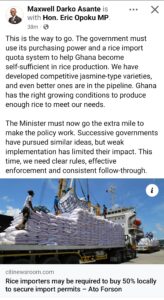
Director of the Council for Scientific and Industrial Research-Ghana (CSIR)-Crop Research Institute and rice breeder, Professor Maxwell Darko Asante, described the proposal as a step in the right direction, saying the government must leverage its purchasing power and introduce a rice import quota system to accelerate Ghana’s drive towards self-sufficiency.
“This is the way to go. The government must use its purchasing power and a rice import quota system to help Ghana become self-sufficient in rice production,” he said.
Prof. Asante noted that Ghana had the potential to produce enough rice to meet domestic demand, citing the development of competitive jasmine-type rice varieties by local researchers.
“We have developed competitive jasmine-type varieties, and even better ones are in the pipeline. Ghana has the right growing conditions to produce enough rice to meet our needs,” he added.
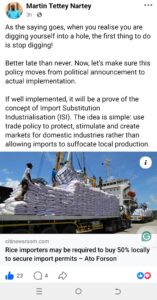
Similarly, an aggregator and miller at Newage Agric Solutions, Martin Tettey Nartey, called for the immediate implementation of the policy, arguing that Ghana could no longer afford to rely heavily on rice imports at the expense of local production.
“As the saying goes, when you realise you are digging yourself into a hole, the first thing to do is stop digging!” he said.
He described the proposed policy as a welcome development but stressed that its success would depend on the government’s willingness to move beyond announcements and ensure effective implementation.
“Better late than never. Now, let’s make sure this policy moves from political announcement to actual implementation,” he said.
Mr Nartey said the proposal, if properly implemented, could demonstrate the effectiveness of Import Substitution Industrialisation (ISI), which uses trade policies to protect domestic industries, stimulate production and create markets for locally manufactured goods.
He, however, cautioned that previous governments had pursued similar policies without achieving the desired results because of weak implementation.
“This time, we need clear rules, effective enforcement and consistent follow-through,” he said, urging the Finance Minister to take the necessary steps to make the policy work.
However, some observers have cautioned against implementing the policy without first ensuring that local farmers and rice processors can meet the additional demand.
A Facebook user, AJ Korankye, said the government must carefully assess the production and supply capacity of local rice farmers before introducing restrictions that could affect imports.
“Until we’re very sure that our local rice farmers are capable of meeting the supply gap created, let’s approach this with utmost care; otherwise, we risk creating a shortage and inflated prices of imported rice,” the user said.
The user also warned against a situation where importers could meet their obligations to purchase local rice but struggle to secure timely deliveries from domestic suppliers.
The Finance Minister announced the proposed policy during an interactive engagement with students and the Kwame Nkrumah University of Science and Technology (KNUST) community on the New Economy.
He explained that an importer seeking a permit to bring in 100,000 metric tonnes of rice could be required to provide evidence of having purchased 50,000 metric tonnes from local farmers.
Dr Ato Forson said deliberate government intervention was necessary to protect domestic agricultural production and prevent rice imports from undermining the livelihoods of local farmers.
He also announced plans to introduce stricter public procurement regulations requiring government-funded institutions to prioritise locally produced rice, particularly for feeding students under the Free Senior High School (Free SHS) programme.
He questioned why local rice farmers continued to struggle to secure markets despite the government’s annual expenditure of approximately GH¢4.5 billion to GH¢5 billion on the Free SHS programme, with about GH¢3.5 billion allocated to feeding students.
The Finance Minister also stated that public expenditure should be deliberately channelled towards creating markets for local producers and supporting domestic businesses.
He further indicated that government will take pragmatic measures, including a legislation, with sanctions for individuals and institutions that violate the new procurement requirements.
Meanwhile, the Ministry of Food and Agriculture revealed that local rice production currently stands at 56 per cent.
“Today on record, we’re producing 56 per cent of our national consumption of rice, so if we have to import, we have to import only 44 per cent. We will not allow importers to exceed 44 per cent, and that is why we’re introducing the Import Quota System so that the market will not be flooded with imported rice, said the Minister of Food and Agriculture, Eric Opoku, when launching the REWARD-GHANA programme at Tamale in the Northern Region on Monday, November, 9, 2026.
The Regional Resilient Rice Value Chains Development Project in West Africa” (REWARD) being implemented by the Ministry of Food and Agriculture REWARD Project is funded with a grant from the African Development Bank (AfDB) aimed at increasing rice production and the marketing and intra-regional trade of the grain.
The Project will cover the Savannah Ecological Zone of Ghana, focusing on seven Districts: Mion, Tamale Metro, Savelugu, Mamprugu Moagduri, Nandom, Wa Municipal, and West Gonja in the Northern, Upper West, North-East and Savannah Regions.
For stakeholders in Ghana’s rice industry, the key test for the Import Quota System will be whether the government can back its words with its actions that guarantee farmers reliable markets while ensuring consistent supply, quality and competitive prices for consumers.