

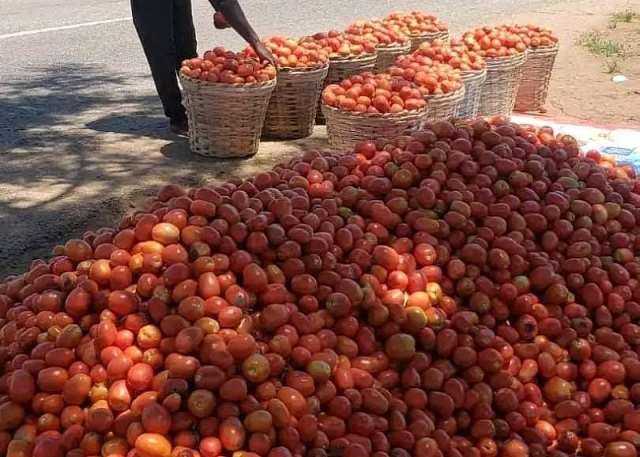
Crate shortages and limited market access are pushing tomato farmers in Anloga-Vume in the Volta Region toward heavy losses, as tonnes of uncollected produce rot in the fields.
A recent trip to the Anloga District, a hub known for tomato and other vegetable production, found heaps of harvested tomatoes lying on sacks along the road, while crates and baskets sat full, waiting for buyers.
According to one of the farmers, Augusta Sefakor Nazar, the area had recorded a bumper tomato harvest this season. She says even though the farmers harvest every day, the market is volatile and usually slows down during weekends because of social activities like funerals and weddings.
“The buyers don’t come on weekends except those from Madina and a few other markets,” she says.
Anazar reveals tomatoes from Anloga can supply nearby markets in the Keta municipality, Ada, Accra, Kumasi in the Ashanti Region, Techiman in Bono East Region and beyond.
“The buyers are coming, but the prices are lower and not stable. A basket is selling between GHS200 and GHS300 for local and hybrid varieties, respectively. By the end of September, the price will start going up again,” she says.
Meanwhile, an Assembly member and a farmer in the Anloga-Vume area, Daniel Kad, tells the Ghana News Agency that the abundant harvest is an ecosystem that goes beyond income for individual farmers.
He says high volume of harvests aligns with national food security, employment for young people engaged in loading, transporting and selling farm produce, and a lifeline for families who depend on the crop for school fees, medical bills and daily survival.
“The immediate cause of the crisis is an acute shortage of crates needed to harvest the tomatoes, compounded by allegations that the few available crates were being controlled by ‘load boys’ who allegedly demand bribes before releasing them to farmers,” he reveals.
He explains that the situation had forced farmers to pay additional illegal charges for the crates.
The lack of storage facilities such as cold rooms for preservation is making the situation worse, Kad says.
“We are issuing an urgent appeal to buyers, market women, processing companies and exporters across the country and beyond to visit Avume immediately. Our tomatoes are ready for harvest but risk being completely lost without swift intervention.”
The development in Anloga started a week before the launch of a national initiative dubbed the Ghana Tomato Self-sufficiency Initiative (GHATSI) by the Ministry of Food and Agriculture (MoFA) and Farmmate Africa on September 15, 2026, at the Anlo Senior High School to transform tomato farming into a more profitable and predictable venture for farmers in the area and the entire country.
GHATSI is a business model with a target to produce 100,000 tonnes of tomatoes across the northern, middle and southern belts for the 2026/2027 season, scaling up to 400,000 tonnes.
Ghana continues to import tomatoes worth 400,000 metric tonnes annually despite having the local capacity to produce enough to meet its demand.
According to MoFA 30-45 of tomatoes harvested in Ghana are lost because of a lack of infrastructure for storage.
“Between 2020 and 2024, Ghana’s tomato production has not exceeded 400,000 metric tonnes. The shortfall has been filled by imports costing over 400 million dollars,” Esther Agyekum, Commodity Lead for vegetables at MoFA, revealed during the launch of GHATSI.
