

Every year, two things happen in the tomato industry: consumers pay more for less in the lean season, while farmers receive less for their labour during the peak season.
2026 is arguably one of the most difficult years for consumers. Ghanaians on social media, especially women, ask about alternatives to fresh tomatoes because of skyrocketing prices.
These posts reflect the reality of the tomato situation in local markets across the country.
The blame is usually laid on the government for not seeking permanent solutions to the recurring problem affecting a country that consumes tons of millions of tomatoes annually.
Ghanaians are likely to see a change in the annual narrative. Farmmate Africa, an organisation with expertise in tomato production, has been at the forefront of a business model that is engaging small-holder tomato farmers across the country.
Describing it as the tomato revolution, in collaboration with the Ministry of Food and Agriculture (MoFA), the company said the initiative is a movement “that promises increased productivity, reliable market access, and improved livelihoods” for a more sustainable tomato value chain, one community at a time.
Farmmate Africa and MoFA launched the Ghana Tomato Self-sufficiency Initiative (GHATSI) in Anloga, in the Volta Region, on Tuesday, September 15, 2026.
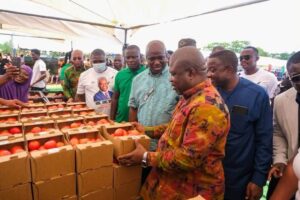
The national launch is a step towards a scheme where outgrowers and farmer groups are engaged on contractual agreements. The project will also focus on community farming enhancement programmes with post-harvest management centres for preservation and value addition.
Before the official launch of GHATSI, Farmmate Africa had several engagements with local farmers in the Volta, Greater Accra, Upper East and West Regions, among others. The Chief Executive Officer, Sena Amevor, explained that the company’s modus operandi connects farmers to financial partners and a ready market for their produce.
“Farmers gain access to loans that help them purchase quality inputs, agrochemicals, and other essential production needs at the right time. Repayment is made after harvest, allowing farmers to focus on achieving higher yields without the burden of upfront costs,” he says.
The GHATSI is five years of work to address a fundamental problem in the industry to make tomato production in Ghana commercially reliable, sustainable for farmers, attractive to investment, and capable of supplying markets all year round. Work has already started, with 200 acres cultivated in Anloga District between May and June, and harvesting has started.
This mission took Farmmate Africa across the country, through the southern, middle, and northern production belts, and across the major, minor, and dry seasons.
“Along the way, we have conducted national and community-level needs assessments, tested different seed varieties and production methods, experimented with irrigation approaches, explored processing and value addition, developed market and distribution channels, and progressively implemented a structured nationwide out-grower model,” Amevor says while addressing the gathering at the launch.
At every step, there are commitments to openness, accountability, and ensuring that every farmer clearly understands how the business works before signing up.
“Together, we’re creating a transparent system that benefits farmers, partners, and consumers alike.”
According to the CEO of Farmmate Africa, another 500 acres were cultivated across Ada East, Ningo Prampram, and Shai Osudoku in July and 300 acres in Asunafo South and Ofinso North in August.
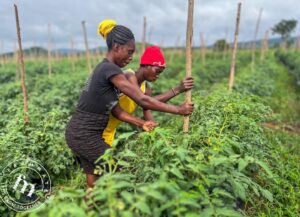
In the northern belt, 1,500 acres across Bawku West, Talensi, and Kassena-Nankana began in September, with another 1,500 acres planned for Sissala West in October. So far, 4,000 acres are under cultivation, with a target to reach 10,000 acres or more by the end of 2027 in 35 districts in 10 regions.
Backed by a comprehensive complementary support package in partnership with Pan African Savings and Loans, a member of the Ecobank Group, the business is designed to help farmers achieve good results while consumers are assured of all-year availability of tomatoes at fair rates.
Under the GHATSI, Pan-African Savings and Loans will work directly with participating farmers, offering an enhancement package estimated at GH¢20,000 per acre, covering inputs, land preparation, soil testing, technical assistance, insurance and other production requirements.
The package is a productive input-credit financing scheme to be settled through a structured off-take arrangement after harvest.
The response from the farmers sparked renewed hope under the business model.
Bright Adzrah, 32, was part of the pilot phase of the GHATSI in Anloga in 2025
His two-acre farm under the bigger project is ready for harvest.
He is confident the contractual agreement he signed with Farmmate Africa can boost his income because of the fixed price at GHS10 per kilogram irrespective of the market situation.
Two of his six-acre tomato farms are under Farmmate Ghana, where the company provided seeds, fertiliser, some funding, and a production protocol to ensure quality.
“This is my first full engagement with them, although last year I did a one-acre demonstration using their seed variety called Abale FZ F1, which performed well,” Adzrah says.
The Abale seed is a high-yielding, dual-season, determinate plum-shaped hybrid tomato variety.
“The price is fixed at GH¢10 per kilogram. So if one basket weighs about 40kg, that gives GH¢400 per basket. Since four baskets make a crate, that’s GH¢1,600 per crate.”
“Now, in the open market, prices can go up to GH¢2,500, which seems better. But when prices drop to GH¢1,000, you lose heavily. With Farmmate, your GH¢1,600 is guaranteed, whether it rains or not,” Adzrah further explains
He goes on to say that stability is very important as it protects farmers from market fluctuations and losses.
Post-harvest decisions must always come first before putting the seeds in the oil.
“Production must be integrated with offtake, post-harvest management, processing, logistics, and distribution. If any link is missing, even a successful harvest can still result in losses,” Sena Amevor of Farmmate Africa says.
He says a crop with high demand, vibrant farmers and enormous economic potential has been left to suffer from seasonal shortages, gluts, post-harvest losses, financing gaps, and market failures, and has been left to thrive on this narrative for far too long.
Under the model, production will rotate in all the tomato-growing districts to ensure an all-year harvest.
“Solutions must begin with the farmer and the production environment. Different communities face different realities—soil conditions, water access, labour structures, and infrastructure vary significantly. What works in one location cannot simply be replicated in another. Interventions must respond to real conditions on the ground,” Amevor explains.
