

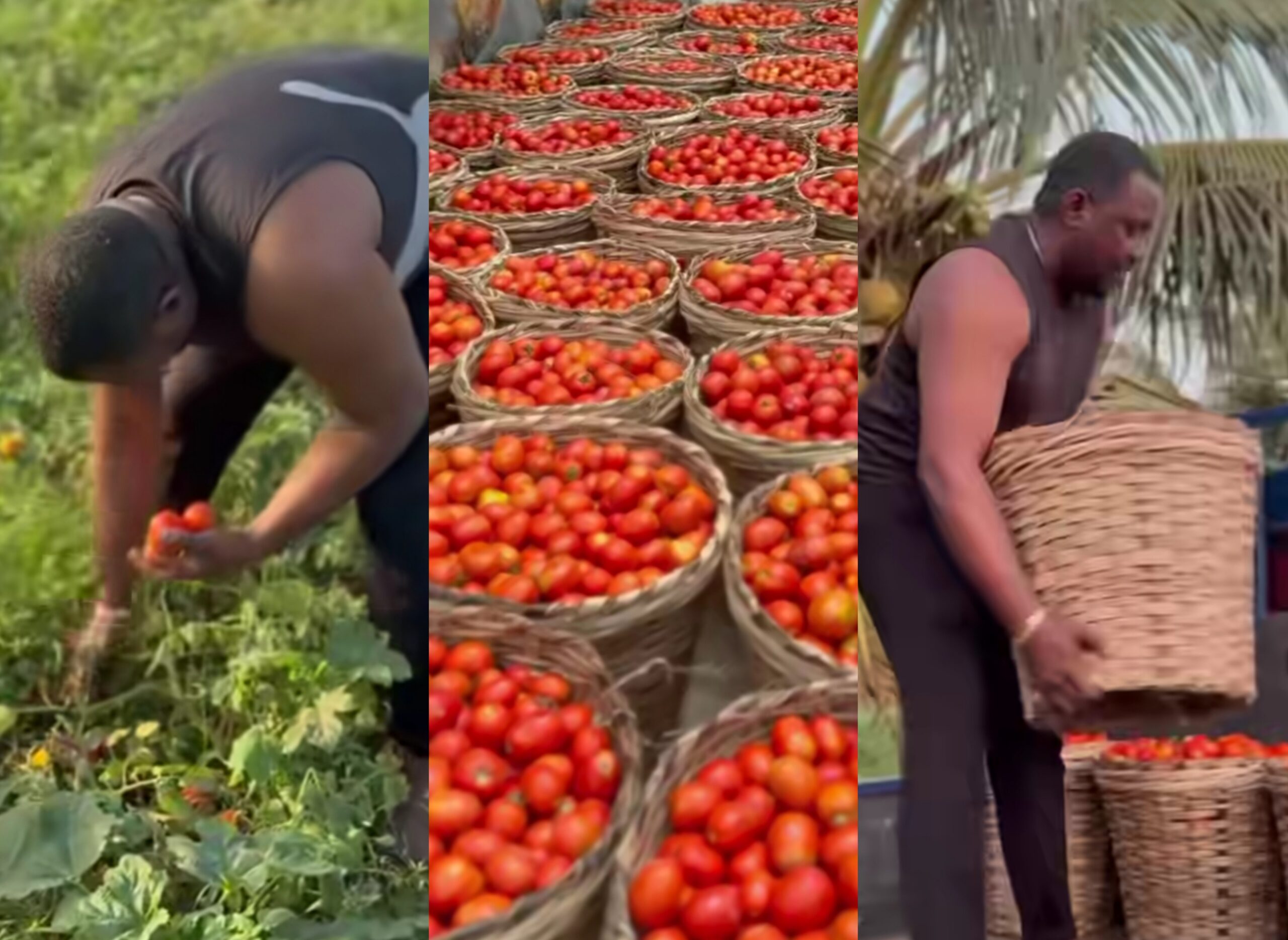
Deputy Minister of Food and Agriculture, John Dumelo, has responded to calls from tomato farmers in Anloga, Volta Region, for buyers by purchasing 100 baskets for school feeding caterers in his constituency, Ayawaso West Wuogon, Greater Accra Region.
After seeing a viral video online, the Deputy Minister joined the farmers to harvest, after which he joined the loading team to pack them in a truck.
He was also seen in the company of a group of women believed to be the caterers at a location in Accra to pick up the baskets of tomatoes.
The glut in Anloga, a tomato and vegetable production hub, has become an annual situation where farmers struggle to find buyers during the peak harvest seasons, even at giveaway prices.
Last week, the farmers in Anloga-Avume complained about tomatoes being left in the field uncollected due to lack of crates.
Some social media users, while commending John Dumelo, however, said that even though the gesture sends a good signal, it is unsustainable. They called on the government and investors to find efficient solutions to the annual problem.
While calling on tomato traders to come to the farmers’ aid, Mr Dumelo announced that a tomato processing factory is being built in Anloga and is expected to be ready next year to address the losses experienced annually.
The glut in Anloga District comes a few weeks after months of tomato scarcity across the country, leaving consumers to pay higher prices for less.
Meanwhile, an Assembly member and a farmer in the Anloga-Vume area, Daniel Kad, tells the Ghana News Agency that the abundant harvest is an ecosystem that goes beyond income for individual farmers.
He says the high volume of harvests aligns with national food security, employment for young people engaged in loading, transporting and selling farm produce, and a lifeline for families who depend on the crop for school fees, medical bills and daily survival.
“The immediate cause of the crisis is an acute shortage of crates needed to harvest the tomatoes, compounded by allegations that the few available crates were being controlled by ‘load boys’ who allegedly demand bribes before releasing them to farmers,” he reveals.
He explains that the situation had forced farmers to pay additional illegal charges for the crates.
The lack of storage facilities such as cold rooms for preservation is making the situation worse, Kad says.
“We are issuing an urgent appeal to buyers, market women, processing companies and exporters across the country and beyond to visit Avume immediately. Our tomatoes are ready for harvest but risk being completely lost without swift intervention.”
In a related development, the Ministry of Food and Agriculture, in partnership with Farmmate Africa, has introduced a business model known as the Ghana Tomato Self-sufficiency Initiative (GHATSI) that will address post-harvest losses and ensure all-year production of tomatoes.
The GHATSI is targeting 100,000 tonnes of tomatoes for the 2026/2027 season, cultivating 10,000 acres across 35 districts in 12 regions.
