

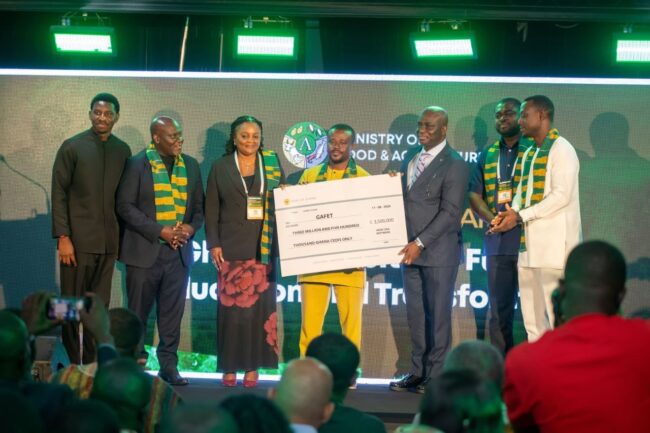
With the venue at The Palms Hotel in Accra filled to capacity and overflowing, the launch of the Ghana Agriculture Fund for Education and Transformation (GAFET) sparked hope for technical and technologically driven training for students in the various agricultural colleges.
Ghana’s agricultural future may not be decided solely on farms, but rather in classrooms, laboratories, and training fields. The launch of GAFET signals a strategic shift, one that recognises that productivity begins with people, not just policy.
With an initial GHS 3.5 million already mobilised, the fund aims to scale to GHS 10 million by December 2026 and GHS 100 million by 2028. These are ambitious targets, but they reflect a deeper urgency: a growing mismatch between the demands of modern agriculture and the skills available in the workforce.
While officially launching GAFET, the Minister of Food and Agriculture, Eric Opoku, indicated the initiative reflects a shift from identifying challenges in the agricultural sector to actively financing solutions, particularly in education and human capital development.
He commended the five founding partners who put resources together to make GAFET a reality.
“These companies understand the realities of Ghanaian agriculture… instead of merely describing the problem, they have chosen to invest in the solution,” the statement said, acknowledging private sector contributions.
Building Brains Before Harvests
For years, stakeholders have lamented about the “skills gap” in Ghana’s agricultural sector. Agribusinesses struggle to find well-trained professionals, while graduates often lack practical exposure. This fund attempts to bridge that divide—not through short-term interventions, but by investing in institutional capacity.
What stands out is its governance model. By separating roles among a governing board, fund managers, custodians, and auditors, the initiative seeks to build credibility in a space often plagued by concerns over transparency. This structure may determine whether private sector confidence holds long enough to meet its funding goals.
More importantly, the fund reframes agricultural education as a shared national responsibility. The Minister appealed to banks, insurers, agribusinesses, and even alumni networks to invest in training infrastructure, research, and scholarships.
“The proposed operational framework provides for clear and separate responsibilities among a governing board, an independent fund administrator or technical advisor, a securities and exchange commission, landers fund manager, a custodian bank, and an independent external auditor.”
According to the Minister, “contributions will be held in a dedicated custodian account. Investment will be governed by an approved investment policy statement with capital preservation and sustainable returns as the guiding objectives. Disbursement will be based on verified institutional needs, formally approved through the fund’s governance structures, and supported by regular audit, reporting, and impact assessments.”
Five Private Sector Partners
Five Ghanaian-led agribusinesses; AgriSolve, GrowForMe, New Age Agric Solutions, Tradeline Consult and Farmerline have come on board as founding partners of GAFET. Aside from providing financial commitments, they will also support the project with their skills and knowledge.
They underscored the urgency of drawing more young people into agriculture by providing hands-on training, access to technology and modern farming infrastructure. Farmerline pledged financial support alongside access to its digital platform, while GrowForMe committed to leveraging its crowdfunding platform to help scale the Fund.
“We are not only putting in cash, but also leveraging technology and training to ensure sustainability,” Farmerline declared.
If successful, the initiative could redefine agricultural education in Ghana—from theory-heavy instruction to a system grounded in innovation and enterprise.
About GAFET
The Ghana Agricultural Fund for Education and Transformation (GAFET), is a national endowment under the policy oversight of the Ministry of Food and Agriculture. It pools contributions from government, agribusinesses, financial institutions, development partners, philanthropists and individuals into a professionally managed fund whose capital is preserved and invested, with annual returns financing approved priorities across Ghana’s agricultural education system.
