

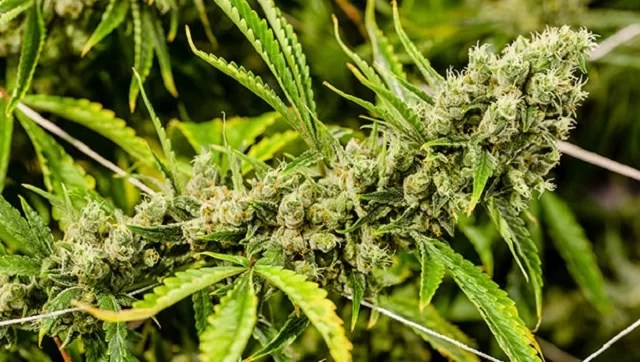
A legal battle is brewing at the Supreme Court as a farmer from Techiman has dragged the government to court over what she describes as prohibitive and unconstitutional licensing fees for industrial cannabis cultivation in Ghana.
Mariam Alhassan, a farmer based in Techiman, has filed a landmark suit invoking the original jurisdiction of the Supreme Court, seeking to strike down the current regulatory framework governing industrial hemp production.
At the centre of the dispute is a licence fee regime that requires farmers to pay up to USD 45,000 (GH¢480,000) per hectare to cultivate Indian hemp legally; a cost the plaintiff argues effectively shuts out ordinary Ghanaian farmers from participating in what is widely touted as a multi-billion-dollar industry.
Defendants Named in Suit
The suit, filed on Friday, February 27, names the Ministry for the Interior, the Narcotics Control Commission (NACOC), the Ministry of Food and Agriculture, and the Attorney-General’s Department as defendants.
According to the court filing, the defendants “acted unfairly and in breach of legitimate expectation by imposing materially higher fees without reasonable accommodation of the consultative process.”
The plaintiff argues that despite extensive stakeholder engagements where industry players advocated for a “proportionate, tiered, and risk-based regulation,” the government proceeded to implement what she describes as “materially higher, unscaled, and cumulative fees.”
‘Designed to Exclude Ordinary Ghanaians’
Madam Alhassan contends that the licensing structure has been crafted in a manner that favours only large, well-capitalised entities, effectively excluding smallholder farmers from the legal cannabis trade.
The suit argues that the absence of a tiered licensing system — which would allow small and medium-scale operators to enter the market at affordable rates — defeats the spirit of inclusivity and undermines the economic empowerment objectives often associated with the legalisation of industrial hemp.
Represented by international lawyer Amanda Akuokor Clinton of Clinton Consulting Partners, the plaintiff is asking the apex court to declare the fee structure unconstitutional.
Constitutional Grounds
The legal challenge is anchored on Article 23 of the 1992 Constitution, which guarantees administrative justice and fair treatment by public authorities. Madam Alhassan maintains that the current framework violates this provision by imposing excessive and disproportionate financial barriers without adequate justification.
She argues that the failure of regulators to incorporate recommendations from stakeholder consultations amounts to administrative unfairness and a breach of legitimate expectation.
Industry at Stake
Ghana legalised the cultivation of cannabis with low tetrahydrocannabinol (THC) content for industrial and medicinal purposes, opening up prospects for investment, job creation, and export revenue. However, critics have long expressed concern that the high capital requirements would sideline local farmers in favour of foreign investors and large corporations.
The outcome of this case could have far-reaching implications for Ghana’s nascent industrial hemp industry. A ruling in favour of the plaintiff may compel regulators to restructure the licensing regime, potentially lowering barriers to entry and expanding access to small-scale farmers.
For now, all eyes are on the Supreme Court as the legal showdown unfolds, with many farmers watching closely to see whether the doors to the hemp industry will be widened — or remain firmly shut.
Reliefs sought
In the Supreme Court filing, Mariam Alhassan (the Plaintiff) seeks the following reliefs against the Defendants:
A declaration that the industrial hemp licensing framework established under section 43 of the Narcotics Control Commission Act, 2020 (Act 1019), as amended, and L.I. 2475, is inconsistent with Articles 17, 23, 36, and 296 of the 1992 Constitution. This is due to its “irrational design, exclusionary economic effect, and disproportionate exercise of administrative discretion”.
A declaration that the high licence fees (up to USD 45,000 per hectare), annual regulatory levies, and percentage-based charges constitute the imposition of de facto taxes. The Plaintiff argues this violates Article 174, which grants taxing power exclusively to Parliament.
A declaration that the requirement for narcotics-style transport permits and armed security escorts for industrial hemp (containing no more than 0.3% THC) is irrational and arbitrary.
An order for the Narcotics Control Commission (NACOC) and other relevant ministries to reconsider and redesign the framework to be constitutionally compliant. This redesign must include:
Tiered, scaled, and risk-based licence fees.
Elimination of narcotics-style transport and escort controls unless objectively justified.
Removal of unscaled, cumulative, and USD-denominated fee structures that exclude ordinary Ghanaian citizens.
An interim order to restrain the enforcement of the challenged fees, levies, and transport/escort requirements until the framework is made compliant.
Any further orders or directions the Court deems fit to safeguard inclusive economic participation and the rule of law.
Details of the suit
Mariam Alhassan, based in the Bono East Region, represents a growing movement of local farmers who view industrial hemp as a transformative cash crop for the middle belt of Ghana. The suit highlights that industrial hemp (cannabis with low THC levels) is a vital raw material for textiles, construction, and medicine, yet the current “unscaled fees” effectively bar local agriculturalists from the supply chain.
The filing raises several critical questions regarding economic governance and the directive principles of state policy:
“If imported hemp goods circulate normally, can domestic production of the same non-narcotic material rationally be treated as a high-risk narcotics activity?”
The plaintiff argues that the difference creates:
• economic exclusion (Article 17)
• irrational administrative action (Articles 23 & 296)
• potential frustration of economic participation goals (Article 36)
and possibly de facto taxation through licensing (Article 174).
Consumers face almost no unusual hurdles, but Ghanaian producers face many.
That mismatch between the free entry of finished hemp goods and the heavy restriction of local hemp cultivation is the constitutional tension at the Supreme Court.
The plaintiff is of the view that if a hemp product is imported into Ghana, such as a hemp body scrub, lotion, oil, or cosmetic containing ≤0.3% THC, such goods typically enter the country through ordinary commercial channels because they are treated as finished consumer goods, not narcotic substances.
However, if a Ghanaian farmer produces industrial hemp of the same grade (≤0.3% THC — the same non-psychoactive material), the activity shifts from product regulation to narcotics-administration regulation under the current framework.
The hurdles identified by the plaintiff include:
High entry licensing
A Ghanaian producer must obtain:
• cultivation licence
• application approvals
• background/security vetting
• compliance clearances
With fees reaching tens of thousands of USD per hectare in some categories.
USD-denominated fees create a structural barrier for local farmers operating in cedis.
• Payments tied to U.S. dollars
• Exposure to exchange-rate fluctuations
• Costs unrelated to farming risk or yield.
Annual regulatory levies
Even after paying licence fees:
• recurring annual charges (e.g., percentage of licence value)
• payable regardless of production success or market conditions.
Layered licensing across the value chain
Separate permissions may be required, with each attracting additional fees for:
• cultivation
• processing
• storage
• transport
• export
• research or testing
Transport permits
Moving harvested hemp within Ghana may require:
• official transport authorization
pre-approved logistics arrangements.
Security / escort requirements
Transport may involve:
• supervised or escorted movement additional security costs
Controls typically associated with controlled narcotics.
Security bonds and compliance costs
Financial guarantees may be required before operations begin.
