

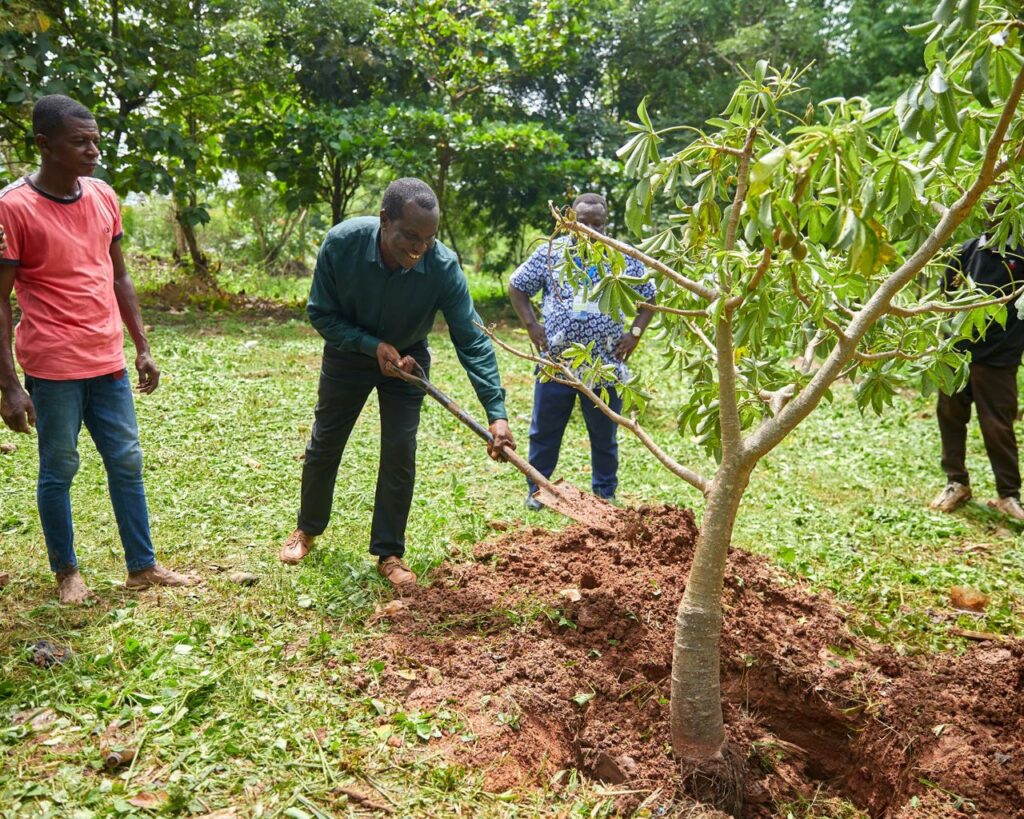
Touted by nutritionists as a superfood, baobab fruit holds huge economic benefits in Ghana that are yet to be tapped.
Its long duration of maturity discourages local farmers and other investors, but the Ho Technical University (HTU) is changing the narrative in a major breakthrough for agricultural innovation, livelihoods and job creation.
With an estimated 30 years to reach the fruiting stage, the school has successfully engineered a fast-maturing variety of the baobab in three years, positioning it to become Ghana’s next lucrative export crop and promising the economic outlook for local farmers.
Overcoming the 30-Year Bottleneck
The climate and drought-withstanding baobab tree, also known as Adansonia digitata, has grown wild across Ghana’s savannah areas, including the Volta Region and the five regions of the north.
Despite its incredible resilience for generations, it has largely not been considered as a commercial cash crop because it traditionally takes over 30 years to bear fruit.
However, the pioneering plant-breeding research led by Ho Technical University has successfully domesticated the species, allowing it to reach the flowering and fruiting stage in 27 months, potentially making baobab farming a highly viable, short-term business venture capable of generating steady foreign exchange for the state.
Economic Value Globally
Baobab fruit is traditionally picked by locals, usually eaten from the pulp and also turned into buttery juice, usually sold at affordable prices. However, HTU’s new innovation and commercial push aims to unlock the tree’s vast global superfood potential.
The baobab is considered a highly versatile biological powerhouse with rich industrial applications. The white fruit pulp is exceptionally dense in Vitamin C, antioxidants, calcium, and potassium, making it highly sought after internationally as a premium powder for smoothies, health supplements, ice creams, and jams.
Baobab oil offers another economic benefit with its incredibly rich vitamins A, D, E, and F properties, making it an elite ingredient in global skincare, cosmetic, and pharmaceutical production.
Beyond the fruit, the leaves serve as nutrient-rich vegetables or can be dried into powder, while the bark and roots provide valuable medicinal and structural materials.
The Volta Reset Agenda Tour Endorsement
The university’s Vice-Chancellor, Professor Ben Q. Honyenuga, shared the breakthrough with President John Dramani Mahama during a town hall meeting held as part of the Volta Reset Agenda tour.
Professor Honyenuga said the innovation could turn baobab into a strategic tree crop for Ghana, providing a new source of export earnings while strengthening livelihoods in rural communities.
He revealed that the university is liaising with the Tree Crop Development Authority to establish a roadmap for commercial production and appealed for government support to elevate the initiative to national importance.
President Mahama welcomed the development, explaining that farmers had previously avoided baobab farming because of the long waiting period before harvesting.
He commended the university’s research team for addressing this challenge, describing the three-year maturity period as a game changer that could attract a new generation of farmers and investors into the sector.
The President pledged his commitment to the initiative and said he would personally consider investing in baobab farming.
Meanwhile, the HTU revealed preparations have begun for model baobab farms in the Volta and Upper West Regions.
