

For months, rice farmers across the country have struggled with huge unsold stocks worth billions of cedis, prompting calls for a temporary ban on imported rice.
In what promises to be a relief in the coming years, the government is preparing to introduce a new policy that will link rice import permits directly to investment in the country’s domestic rice sector, in what officials describe as a major step toward achieving self-sufficiency and reducing the nation’s growing import bill.
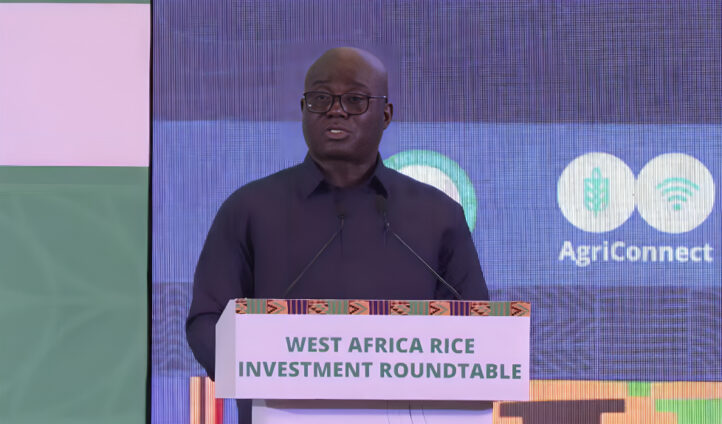
The policy was announced by the Minister of Food and Agriculture, Eric Opoku, during the West Africa Rice Investment Roundtable held in Accra. The two-day high-level event brought together policymakers, development partners, and private sector leaders, including Vice President Prof. Jane Naana Opoku-Agyemang, President of the ECOWAS Commission Dr Omar Alieu Touray, World Bank Vice President for Planet Guangzhe Chen, and Deputy Finance Minister Thomas Nyarko Ampem.
The announcement was met with loud applause from participants, reflecting broad support for a reform many believe could reshape Ghana’s rice value chain.
Under the new regime, rice importers will no longer be able to secure permits without demonstrating clear and verifiable partnerships with local rice producers or investments in the domestic sector.
“Government will implement an import quota policy that directly links the privilege of importing rice to the growth of domestic production,” Mr Opoku emphasised.
He explained that importers must provide evidence of procurement agreements or investment arrangements with Ghanaian rice farmers and millers before being granted approval to import.
Despite the sweeping nature of the reform, the minister sought to calm fears among consumers and traders about possible price hikes or supply shortages.
“We are not raising tariffs that punish consumers. We are not imposing bans that create shortages,” he stated.
Instead, he said, the policy is designed to redirect value from imports into building Ghana’s own production capacity and strengthening the local rice industry.
The move comes at a time when many local rice farmers have been battling a glut over the past year, struggling to sell their produce due to limited market access and competition from cheaper imported rice. In several farming communities, harvested paddy has remained unsold for months, leading to financial strain for farmers and millers.
Industry players say the glut has exposed deep structural challenges in the sector, including weak linkages between producers and buyers, inadequate processing capacity, and poor distribution networks. The new policy is expected to address these gaps by guaranteeing a market for local rice through importer partnerships.
Ghana’s dependence on imported rice continues to weigh heavily on the economy. Last year, the country consumed about 1.71 million tonnes of rice, while domestic milled production reached approximately 960,000 tonnes. The shortfall of nearly 751,000 tonnes required imports costing around $320 million.
Although self-sufficiency has improved to about 56 per cent; up from roughly 45 per cent at the start of the decade, the government says progress must accelerate significantly to achieve full self-reliance.
According to Mr Opoku, imports will be reduced gradually over the next decade, with each reduction tied to measurable increases in local production.
“We will not create a gap we cannot fill,” he assured stakeholders.
Government projections indicate that achieving 100 per cent self-sufficiency within ten years has the potential to save Ghana about $2.1 billion in foreign exchange, attract more than $400 million in private investment, and create over 200,000 jobs across farming, processing, logistics, and related sectors.
He described the rice industry as the country’s “single largest untapped agribusiness opportunity.”
To support the policy, the Mr. Eric Opoku disclosed that the government is also deploying satellite-based geospatial mapping technology, developed in collaboration with the World Bank and experts from the NASA Harvest programme.
The initiative will identify and classify suitable land for rice production nationwide, providing investors with detailed data on production potential and irrigation opportunities.
The minister noted that combining data-driven planning with guaranteed market access through the quota system would help reduce risks for investors and unlock capital for large-scale expansion.
The import reform is part of the broader Feed Ghana Programme, which includes investments in irrigation, mechanisation, improved seed systems, post-harvest infrastructure, and value addition. The programme also aims to curb rice smuggling and promote local consumption through the “Buy Ghana First” initiative.
With the new policy, the government believes Ghana is taking a decisive step toward building a resilient and competitive rice sector that will not only reduce imports but also ensures that local farmers, who have been long burdened by gluts and limited market access, will finally have a reliable pathway to profitability.
