Close Menu

    Subscribe to Updates

    Get the latest creative news from FooBar about art, design and business.

    What's Hot

    The Solution Is There! Experts Slam Government Inaction Over Ginger Shortage

    May 18, 2026

    Farmers Sidelined As Govt Contractors Supply Imported Rice To Schools Instead Of Local Rice

    March 9, 2026

    Chocolate Company To Manufacture Lab-Grown Cocoa: What Does It Mean For Ghana’s Cocoa Farmers?

    March 9, 2026
    Facebook X (Twitter) Instagram
    Facebook X (Twitter) Instagram
    The Ghanaian Farmer
    Subscribe
    • Homepage
    • Agribusiness
    • AgriTech News
    • Livestock
    • Crops
    • Farmer’s Spotlight
    The Ghanaian Farmer
    Home » The Solution Is There! Experts Slam Government Inaction Over Ginger Shortage
    Agribusiness

    The Solution Is There! Experts Slam Government Inaction Over Ginger Shortage

    SefakorBy SefakorMay 18, 2026No Comments3 Mins Read
    Facebook Twitter Pinterest LinkedIn Tumblr WhatsApp VKontakte Email
    Share
    Facebook Twitter LinkedIn Pinterest Email

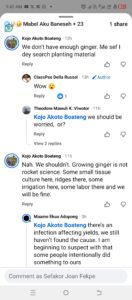
    The conversation started in reaction to news of imported ginger from China; frustrated, practical, and laced with immediacy.

    For Kojo Akoto Boateng, an Agribusiness Strategist and Farmer, the solution to Ghana’s ginger crisis has been on our laboratory shelves.

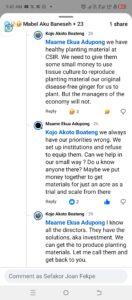
    The country already had what it needed. At the labs of Council for Scientific and Industrial Research (CSIR), lies healthy, disease-free ginger planting materials; carefully developed, and ready to be multiplied through tissue culture.

    What was missing wasn’t knowledge. It was an investment.

    “We have the planting material,” Kojo insisted. “Just a little funding to reproduce it, and farmers can begin again.”

    On the other side of the conversation, Maame Ekua Adupong, one of the people being hit hard, understood the crisis not as mere talks, but as daily loss. Her powdered ginger business, once sustained by a steady network of local farmers, had begun to crumble under the weight of scarcity and rising prices.

    “We always get our priorities wrong,” she replied. “We set up institutions and refuse to equip them.”

    Still, she was determined. If there’s no action from the government, perhaps private effort could fill the gap. Even a single acre as just one experimental plot using improved planting material
    could be enough to prove a point, to restart a cycle, to rebuild supply.

    Kojo agreed. The expertise was there. The scientists were ready. What remained was the will and the money.

    But outside of policy conversations and research institutions, the impact of that missing link was already being felt in the streets.

    In Lebanon, a busy enclave within Ashaiman, Ophelia Ayenu had quietly dropped her tray and walked away from a trade she once knew so well.

    She used to sell ginger.

    Ophelia had built relationships. Customers who relied on her. She walked daily hawking her ginger across neighborhoods, supplying homes and food vendors. It was hard work, but it paid.

    Then the shortages began, lasting longer than expected.
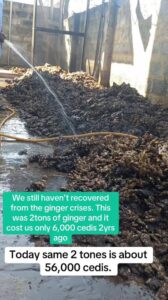
    Prices climbed. Supply dwindled. What used to be predictable became unstable. Eventually, it stopped making sense to continue. The margins disappeared, and with them, her business.

    Now, Ophelia walks the same streets, but with a different load; footwear arranged in an oval shaped plastic basket . She sells on credit, chasing payments and negotiating with customers. The profits are smaller, the uncertainty greater.

    “I made more from ginger, but I can’t sell anymore. It’s too expensive and hard to get,” she admits quietly.

    Her hope is simple: that whatever the problem is, will be fixed.

    Back on Facebook, Kojo and Maame Ekua are still talking about tissue culture, about funding, about starting small and scaling up. Their conversation reflects a broader truth: Ghana’s ginger crisis is not just about crops. It is about broken links between knowledge, policy, and action.

    Until those links are restored, the ripple effects will cripple businesses; from research institutions left underfunded, to processors struggling to stay afloat, to traders like Ophelia, forced to abandon livelihoods that once worked.
    Share this:

    • Share on Facebook (Opens in new window) Facebook
    • Share on X (Opens in new window) X

    Like this:

    Like Loading...
    Share. Facebook Twitter Pinterest LinkedIn Tumblr WhatsApp Email
    Previous ArticleFarmers Sidelined As Govt Contractors Supply Imported Rice To Schools Instead Of Local Rice
    Sefakor
    • Website

    Related Posts

    Farmers Sidelined As Govt Contractors Supply Imported Rice To Schools Instead Of Local Rice

    March 9, 2026

    Chocolate Company To Manufacture Lab-Grown Cocoa: What Does It Mean For Ghana’s Cocoa Farmers?

    March 9, 2026

    Plantain Chips Producers Demonstrate Against Claims Of Using Plastics For Frying

    March 2, 2026

    Ghanaian Farmers To Pay Up To GH¢480,000 Licence Fee for a Hectare of “Wee” Farm; Farmer Fights Gov’t At Supreme Court

    March 2, 2026

    Leave a ReplyCancel reply

    Demo
    Our Picks

    Remember! Bad Habits That Make a Big Impact on Your Lifestyle

    January 13, 2021

    The Right Morning Routine Can Keep You Energized & Happy

    January 13, 2021

    How to Make Perfume Last Longer Than Before

    January 13, 2021

    Stay off Social Media and Still Keep an Online Social Life

    January 13, 2021
    • Facebook
    • Twitter
    • Instagram
    • YouTube
    • LinkedIn
    Don't Miss
    Agribusiness

    The Solution Is There! Experts Slam Government Inaction Over Ginger Shortage

    By SefakorMay 18, 20260

    The conversation started in reaction to news of imported ginger from China; frustrated, practical, and…

    Share this:

    • Share on Facebook (Opens in new window) Facebook
    • Share on X (Opens in new window) X

    Like this:

    Like Loading...

    Farmers Sidelined As Govt Contractors Supply Imported Rice To Schools Instead Of Local Rice

    March 9, 2026

    Chocolate Company To Manufacture Lab-Grown Cocoa: What Does It Mean For Ghana’s Cocoa Farmers?

    March 9, 2026

    Plantain Chips Producers Demonstrate Against Claims Of Using Plastics For Frying

    March 2, 2026

    Subscribe to Updates

    Get the latest creative news from SmartMag about art & design.

    About Us
    About Us

    The Ghanaian Farmer is Ghana’s leading agricultural news and advocacy platform, dedicated to informing, educating, and inspiring farmers and agribusiness stakeholders. We spotlight innovations, share success stories, and promote sustainable practices to strengthen Ghana and Africa’s food systems

    We're open to do busines with you and amplify your agriculture business.

    Email Us: info@theghanaianfarmer.com
    Contact: +233 554830431

    Our Picks

    Remember! Bad Habits That Make a Big Impact on Your Lifestyle

    January 13, 2021

    The Right Morning Routine Can Keep You Energized & Happy

    January 13, 2021

    How to Make Perfume Last Longer Than Before

    January 13, 2021
    New Comments
    • John on Climate Change And The Need For Forest Protection In Ghana
    • Sefakor on Cashew Development In Ghana; What Has Changed? Nana Yaw Reuben writes
    • https://yourkinkinpink.com on Commercialisation Of Farming Drives Market And Investment- Rice Farmer
    • tokyovipjapanesecompanions.com on Commercialisation Of Farming Drives Market And Investment- Rice Farmer
    Facebook X (Twitter) Instagram YouTube LinkedIn
    © 2026 The Ghanaian Farmer. Designed by AJ Willz Media.

    Type above and press Enter to search. Press Esc to cancel.


    Loading Comments...
     

      %d