

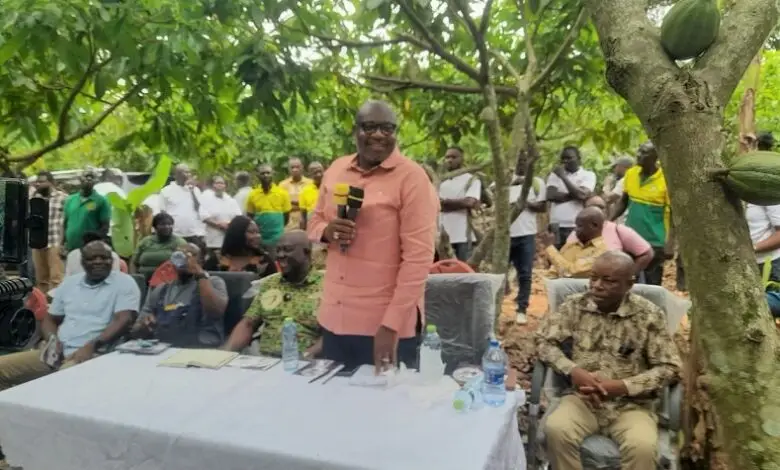
Following calls for an increase in cocoa price for farmers, the Ghana Cocoa Board
(COCOBOD) has assured farmers of deserving upward price adjustment higher than that of its regional competitor, Côte D’Ivoire.
The Chief Executive Officer, Dr. Randy Abbey revealed that the producer price increment for 2025/2026 will take effect in August this year.
He announced this during a meeting with cocoa farmers at Duayaw-Nkwanta in the Tano North Municipality of Ahafo Region, as part of a working visit to the Bono and Ahafo regions.
Speaking directly to farmers, Dr. Abbey warned against hoarding and smuggling of cocoa beans, which some producers engage in while waiting for potentially higher prices from neighboring countries like Côte D’Ivoire.
In an effort to retain loyalty and prevent illegal cross-border sales, he stated; “the 2025/2026 producer price of cocoa would be announced in August this year. Government intends to give farmers a price which will be bigger than what our neighbours, Ivory Coast, would offer their farmers”.
Cocoa Farm Rehabilitation
Meanwhile, COCOBOD has announced the resumption of its cocoa farm rehabilitation programme, aimed at tackling the devastating impact of Cocoa Swollen Shoot Virus Disease (CSSVD) and boosting national production.
Dr. Randy Abbey disclosed that of the 156,000 hectares affected by CSSVD, 40,000 hectares were rehabilitated and returned to farmers in 2024. Another 27,000 hectares, however, were abandoned mid-way due to funding constraints.
The announcement highlights growing competition between West Africa’s top cocoa producers, as both countries jostle to keep their farmers motivated amidst global market fluctuations and internal production challenges.
COCOBOD is also introducing climate adaptation strategies to stabilize production. Boreholes will be drilled across cocoa farms to combat the impact of rising temperatures and erratic rainfall patterns, which threaten crop yields.
Farmers have responded with cautious optimism but continue to call for more systemic support. Financial assistance for labor and farm inputs was a key request from the Brong Ahafo Women Cooperative Farmers and Marketing Central Women Union Limited (BAWCOF).
The president of BAWCOF Martha Addai also revealed; “The Union cultivated 6,857.82 hectares of cocoa, producing approximately over 8,000 bags of cocoa beans annually.”
With 7,129 women across 96 cooperatives, the union has pledged support to the new COCOBOD administration, but urged access to petty loans to keep operations afloat.
The cocoa sector, which is a pillar of Ghana’s economy, is now at a crossroads—with price policies, climate solutions, and farmer support all playing pivotal roles in its path forward.
