

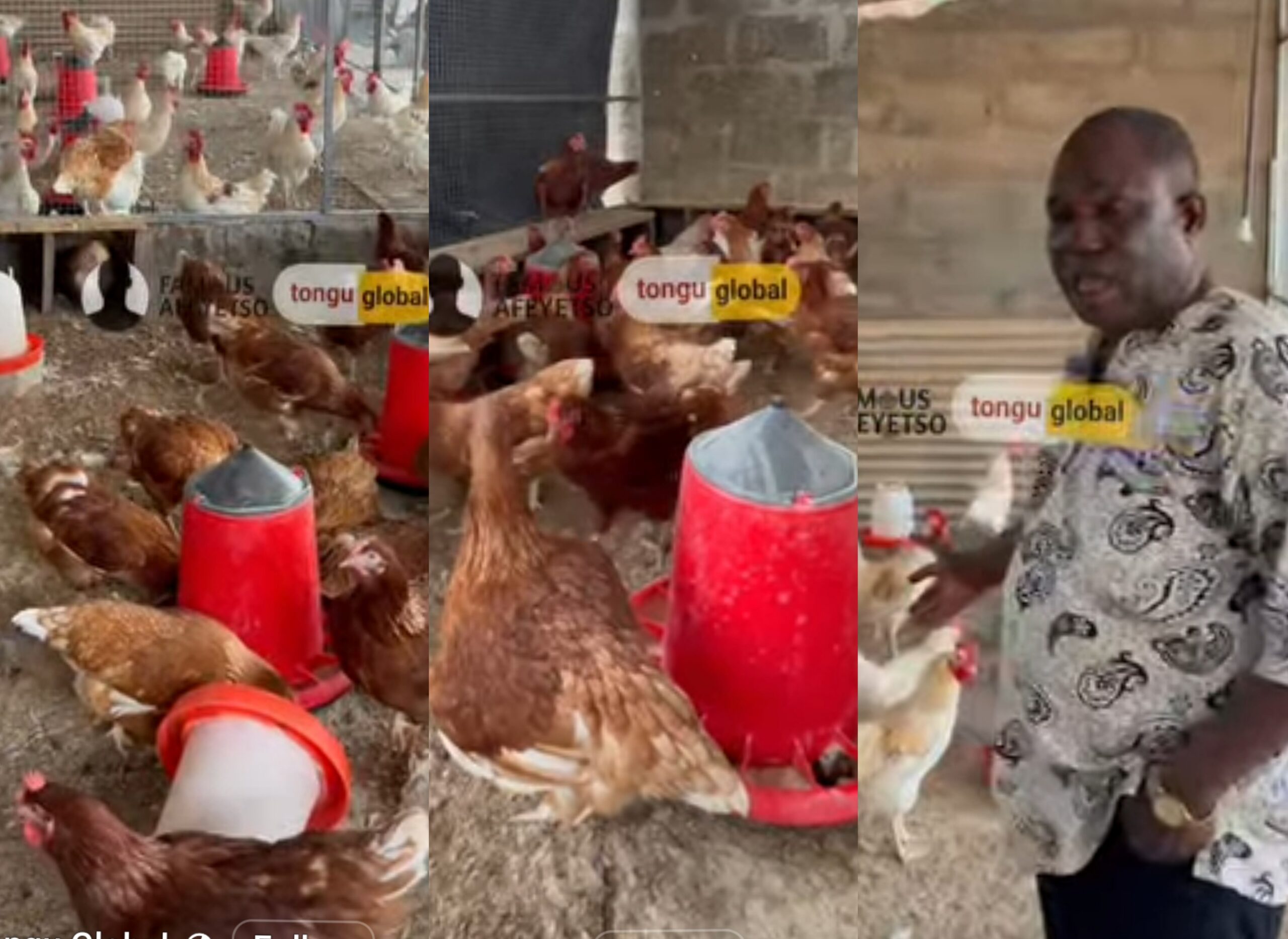
Amuga Adukonu, a beneficiary of government’s Nkoko Nkitinkiti poultry programme in Mepe in the North Tongu District of the Volta Region, says the initiative is already serving as a new source of income for his family.
He had no prior experience in poultry farming when he received 100 birds under the programme.
Adukonu is a welder by profession. He did not allow his lack of experience in poultry farming to discourage him. He sought guidance from people already engaged in the business and applied what he learned to raise the birds.
“I didn’t have any experience in poultry farming, so I fell in with those who are already in the business and know how to make it work,” he said in an interview with Tongu Global.
Adukonu currently has 90 of the 100 birds he received, having lost 10. Some of the surviving birds have started laying eggs, and he now collects an average of three crates of eggs daily.
He received 70 female and 30 male birds.
For Adukonu, the flagship programme has provided an opportunity to diversify his livelihood beyond welding.
“I’m a welder, and I’m confident this is going to serve as another source of income that can help me support my family,” he said.
Building The Structure
Adukonu said he took steps to prepare for the programme even before receiving the birds. After learning about the Nkoko Nkitinkiti initiative in North Tongu, he constructed a cage with a capacity of about 400 birds, hoping to eventually expand his flock.
However, because others also needed to benefit from the programme, he received 100 birds.
Adukonu is based in Aveyime but uses a piece of land he owns in Mepe for the poultry business because he does not have adequate space at his residence.
He leveraged his experience as a welder to ensure he had the structures in place before accommodating the birds.
After learning that the birds had arrived in the district through a social media video, he brought his children to Mepe and quickly put up the structures needed to accommodate the birds.
“I brought my children here, and we quickly constructed the structures you see here,” he said.
Adukonu says his experience demonstrates the importance of beneficiaries taking ownership of government interventions rather than simply waiting for support.
“When there’s a government project in which citizens are supposed to benefit and make it successful, we should not be pessimistic. We need to embrace it and make sure it delivers for the economic development of our country,” he said.
Plans To Expand
With the birds already producing eggs, Adukonu is now looking beyond the initial 100 birds.
“My plan is to expand the business because it looks very promising,” he said.
His initial aim was simply to test whether poultry farming could work for him. The early results have strengthened his confidence in the venture.
“My intention was to try it and see if it would work, and indeed it’s looking good,” he said.
Adukonu’s approach to the poultry programme reflects a broader argument that government agricultural interventions can generate sustainable livelihoods when beneficiaries complement public support with their own investments, skills and initiative.
His willingness to construct a larger poultry facility before receiving the birds also gives him room to scale up beyond the initial support.
He says the poultry venture is not his first experience with a government-supported initiative.
Adukonu says he also participated in a tree-planting programme introduced by a previous government. He planted some of the seedlings on unused land, where they have since grown significantly.
“If you see them today, you will be amazed,” he said.
Adukonu expressed confidence that the poultry project represents another opportunity to turn available resources into a productive enterprise. He has an immediate goal of increasing egg production, expanding his flock and creating a more reliable income for his family.
Beyond poultry ventures, the Nkoko Nkitinkiti program is an economic recovery tool and a job programme to contribute to national efforts to reduce dependence on imported poultry products and strengthen food security.
The initiative, under the Feed Ghana Programme, distributed poultry to various beneficiaries and is expected to decrease poultry imports by 10-15 per cent in the initial phase.
According to the National Coordinator, Bright Demordzi, this translates to saving between USD30-60million annually during the launch in the Volta Regional capital, Ho in June.
He said the project will create direct and indirect jobs ranging from feed milling, hatcheries, veterinary services, transport, processing, and marketing.
In the medium term, Demordzi said it is projected to cut Ghana’s poultry import bill by more than 50 per cent, while repositioning the country toward self-sufficiency in poultry meat and eggs.
