

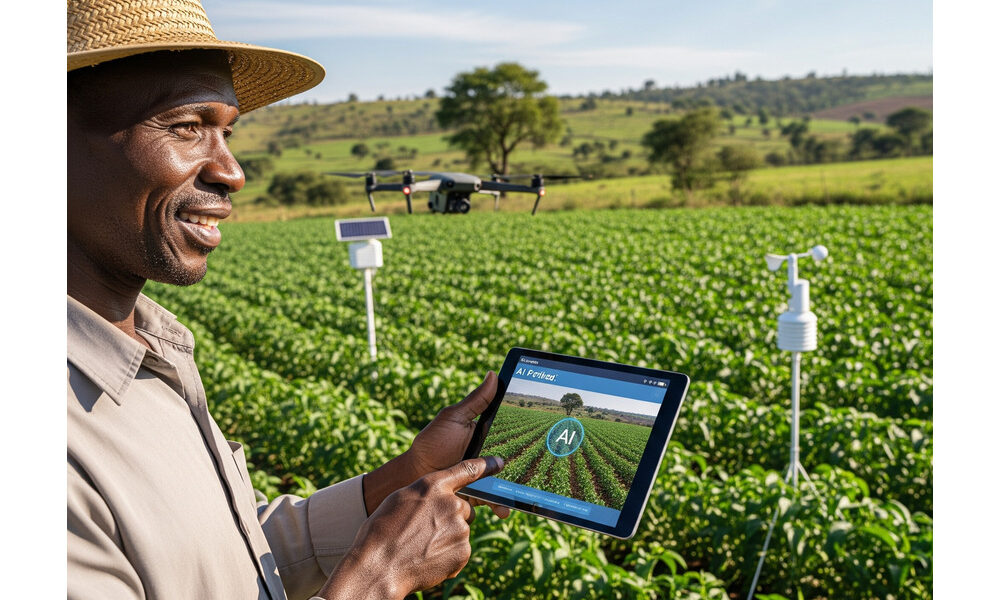
The World Bank has said that the global agrifood system stands at a critical inflection point where climate shocks, rising input costs, fragile supply chains, and widening inequality are placing unprecedented pressure on food production and distribution.
According to the Bretton Woods Institution, Small-scale producers who produce one-third of the world’s food are especially vulnerable.
In the view of the World Bank, Artificial Intelligence (AI) presents a timely and powerful tool to help reimagine agricultural transformation in ways that are more productive, sustainable, and inclusive.
The World Bank made these remarks in a report, Harnessing Artificial Intelligence for Agricultural Transformation.
The report was produced by the World Bank’s Agriculture and Food Global Practice with global partners.
“AI offers transformative potential, but it is not a universal solution. Not every problem in agriculture requires AI, and not all AI investments will deliver equitable returns,” the World Bank says.
It argued that strategic deployment requires clear-eyed cost-benefit analysis, identifying where AI adds distinctive value; such as in processing unstructured data at scale, enabling predictive insights, or personalising services in low-connectivity environments. In many contexts, simpler digital tools, better data governance, or improved institutions may yield more immediate and sustainable impact.
According to the World Bank, it is important to manage risks associated with agricultural technology and AI. AI systems, if poorly designed or unaccountably deployed, can reinforce inequalities, replicate biases, undermine privacy, and impose environmental burdens. Least Middle Income Countries (LMIC) face vulnerabilities given limited regulatory capacity, underrepresentation in global datasets, and unequal access to computing infrastructure.
The World Bank recommended inclusive governance, locally relevant datasets, and strong public oversight are essential to ensure that AI deployment in agriculture advances and does not undermine development goals.
For policymakers, the report recommends them to adopt National AI Strategies inclusive of agriculture, with clear implementation pathways and budgets.
It also asks them to embed AI in AgriFood System Policy by linking it to resilience, climate adaptation, and nutrition security goals.
AI can be the engine of a new agricultural revolution – one that is digital, inclusive, and sustainable. But realizing this vision will require discernment: deploying AI where it offers true strategic value, and resisting hype where simpler, more appropriate solutions suffice.
With the right investments in infrastructure, governance, and capacity, and a commitment to inclusion and ethics, AI can help reshape agrifood systems for the better. This report provides a practical blueprint for that transformation – placing LMICs farmers at the center of the AI era, and aligning innovation with equity, resilience, and public good.
Story by Kofi Nartey
