

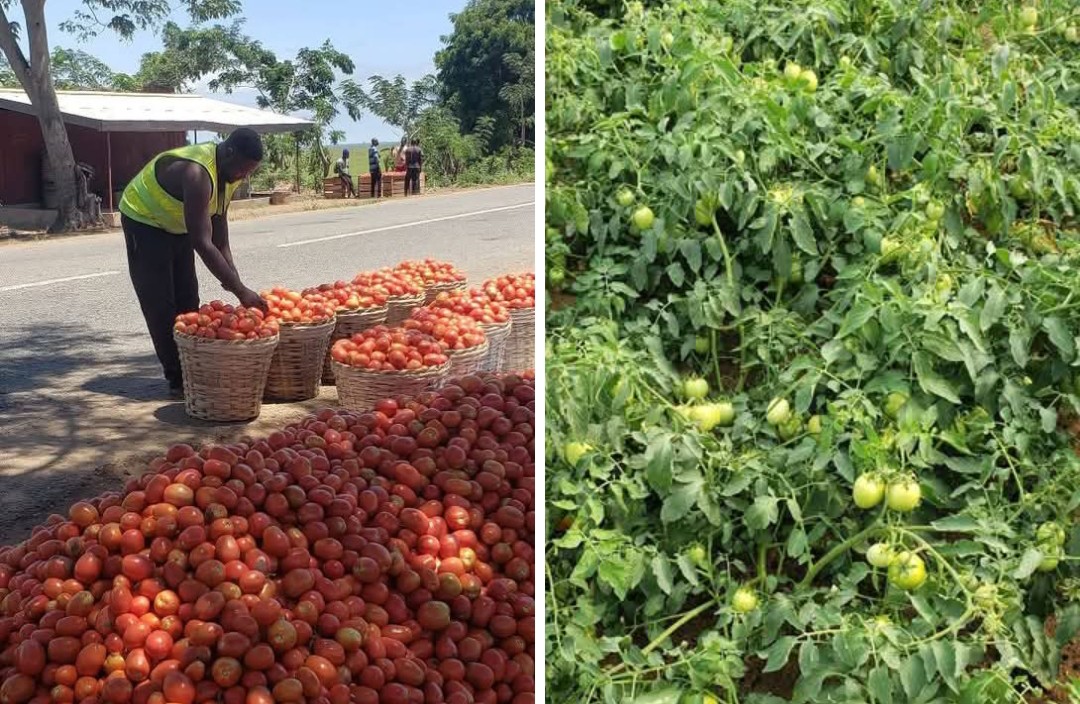
On tomato fields in Anloga District of the Volta Region, abundance and scarcity exist side by side.
It is early morning, 32-year-old farmer Bright Adzrah, walks through rows of ripening tomatoes on his four-acre farm. The plants are heavy with fruit giving hope for his 60 tonnes target, yet not all of it will make it to market.
“Yesterday, I harvested about 44 crates,” he says. “The rest are still on the farm because I don’t have buyers and even crates to carry them.”
It is a striking contradiction in a year when consumers across Ghana have complained about soaring tomato prices and erratic supply.
High Yields, Uncertain Markets
Adzrah is not struggling with production. In the last three planting seasons, the yields from his farm consistently recorded a strong trend, averaging more than 15 tonnes per acre. According to a tomato production guide from the Ministry of Food and Agriculture, good agronomic practices can produce 35-40 tons per hectare.
In 2024, he harvested 22.2 tonnes per acre using the Cobra 34 variety. He switched to yaqui the following year, recording 18.1 tonnes per acre. In the 2026 season, he cultivated Sika F1, which he estimates will still deliver above 15 tonnes per acre.
Across his four acres, he expects to harvest more than 60 tonnes.
But high yields do not guarantee strong returns.
“We are producing, but the buyers are not coming,” he explains.
A Climate Problem In Disguise
Central to the problem is a changing climate that is silently reshaping tomato farming in Anloga.
When temperatures are erratic the crop struggles to set fruit.
“In recent times, the night temperatures have not been favourable,” Adzrah says. “When it is too hot, the flowers abort. The plant grows, but it does not fruit.”
Even though Adzrah and the thousands of farmers in Anloga rely heavily on irrigation infrastructure, poor climate has made it difficult for farmers to rely on even their best-performing varieties.
While yaqui has the potential to outperform other varieties, it is highly sensitive to temperature changes. As a result, farmers are forced to switch between varieties, often sacrificing maximum yield for stability.
He says the lack of heat-tolerant tomato varieties means Anloga’s production remains locked into a single seasonal window.
The planting season starts between June and August, with harvesting running from August to November. After that, production drops sharply.
“After November, tomatoes are finished here,” Adzrah says. “We have water for irrigation, but the varieties cannot withstand the heat.”
This seasonal gap gives a better appreciation of a long-standing puzzle: why traders travel to Burkina Faso for tomatoes even when Ghana has strong production areas like Anloga.
According to Adzrah the quest for tomatoes from Burkina is about timing, not quality.
“They go to Burkina Faso between February and April because we are not producing at that time,” he explains.
Imports And Local Reality
According to a recent research by the Council for Scientific and Industrial Research (CSIR), fresh tomato imports, mainly from Burkina Faso, are estimated at between 100,000 and 120,000 metric tonnes annually, costing Ghana about US$18 million.
But Adzrah insists local production in Anloga tells a different story.
“Here in Anloga alone, we produced about 240,000 tonnes,” he claims, citing district agriculture figures.
There are different online posts pointing to the same figures. It suggests that Ghana’s tomato challenge is not just about production volume, but weather, timing, distribution, market access.
The imports are done during the off season. A technology for year round cropping is the way, he says.
The Price Tug-of-War
In the midst of peak harvest, farmers face another hurdle; pricing.
Adzrah says a box of tomatoes currently sells for around GHS2,800 at the farm gate. But traders often push for lower prices, offering GHS2,500.
“The same traders buy from Burkina Faso at much higher prices,” he says. “But when they come here, they want to reduce the price.”
Without reliable buyers or structured markets, farmers are left with little bargaining power—especially when their produce is perishable.
Breakdown In Coordination
Beyond climate and poor pricing, another pressing issue is how the market is organised.
Farmers must find buyers themselves, rather than buyers coming to them to guarantee ready market and avoid post-harvest losses. Limited access to logistics such as crates also puts the harvests at risk.
Adzrah, who holds a degree in agriculture from the University of Cape Coast, believes the problem is solvable.
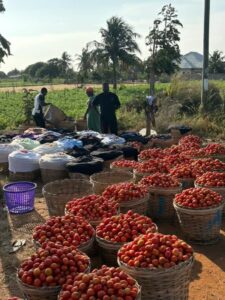
His passion for the industry led him to focus on post-harvest management, during his undergraduate studies. He argues that proper coordination between farmers, traders and authorities could significantly reduce losses.
“We can organise ourselves and create awareness for the market women,” he says. “But leadership and coordination are lacking.”
Tapping The Potential
Despite the challenges, the scale of opportunity in Anloga is hard to ignore.
The district is a major hub for tomato production, with hundreds of hectares under cultivation. With irrigation facilities dotted in every part of Anloga, the missing piece is the right seed for all-year production.
“If we get a variety that can withstand the heat, Anloga alone can feed Ghana,” Adzrah says.
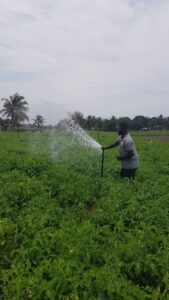
In the district, the fruits of farmers’ labour are visible in the fields. But without climate-resilient seeds and better market systems, much of the labour is going to waste.
“We are producing. The problem is not production. The problem is everything after that,” he says.
