

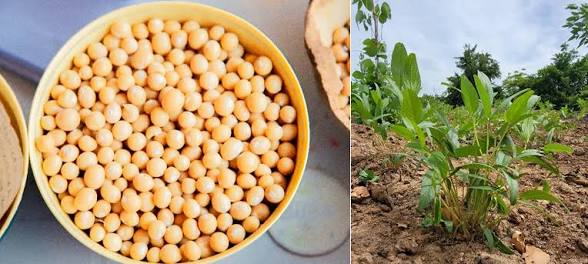
Neglected indigenous crops offer potential alternative sources of livelihoods to address climate challenges as a result of environmental degradation leading to biodiversity loss, food insecurity and poor nutrition.
According to a Senior Research Scientist at CSIR-PGRRI, DR. Martilda Bissah biodiversity loss increasingly puts Ghana’s food systems at risk.
While speaking at a Biodiversity Media Learning Initiative workshop, she revealed that many neglected and underutilised crops preserved by local communities have the potential to address food insecurity and climate challenges, however they continue to receive little to no policy intervention to protect them.
The workshop was organised by the Council for Scientific and Industrial Research-Plant Genetic Resources Research Institute (CSIR-PGRRI), the World University Service of Canada (WUSC) and the International Union for Conservation of Nature (IUCN) at Bunso in the Eastern Region.
The Ghana National Genebank under the management of the CSIR-PGRRI conserves 81 out of 101 neglected and underutilised crop species identified globally as important opportunity crops.
“We need to promote them, we need to get people to utilise them for food, medicine and income generation,” reiterated.
Dr Bissah made reference to CSIR-PGRRI’s successful interventions targeting Bambara groundnuts, indigenous leafy vegetables and taro, saying conservation and utilisation of genetic resources had contributed to strengthening crop resilience and improving livelihoods.
While expressing disappointment over lack of stringent measures, she called for deterring policy intervention to ensure perpetrators of environmental degradation bear greater responsibility.
“There are no policies that facilitate getting these people to pay for the degradation of the genetic resources they degrade,” she said.
The Head of Commercialisation at CSIR-PGRRI, Victor Nkekia revealed that nutmeg is a huge economic crop and highly profitable.
As Ghana imports significant quantities of nutmeg, participants of the event were shocked to discover nutmeg does well in the country with trees planted in the 1960s at the Gene Bank currently bearing fruits.
Mr. Nketia said the crop performs well in parts of the country and offers considerable commercial potential and serves as a perfect climate resilient crop.
“The last time I checked, a bag of nutmeg was sold for around GH¢7,000 to GH¢8,000,” he said.
He said there’s the need for increased investment in research, commercialisation and awareness for farmers to create jobs, reduce imports and improve incomes.
A tour of the national Gene Bank revealed one thing; sustained investment but the scientists say the institution is financially handicapped and currently operating at low capacity.
Whereas the scientists have devoted themselves to conservation, civil society organizations argue that there’s the need for awareness at the national and community levels for locals to be responsible for environmental protection.
The Project Coordinator of the Nature-Based Climate Adaptation in the Guinean Forests of West Africa Project,Mr Rusmond Didewuyem Anyinah said the WUSC, which has operated in Ghana for almost three decades, collaborated with CSIR-PGRRI and IUCN to expose journalists to biodiversity conservation measures that often receive little public attention.
“Today’s event basically is to expose our media professionals to some of the conservation mechanisms and approaches that our partner, CSIR-PGRRI, is using to promote biodiversity conservation in Ghana,” he said.
Mr Anyinah said the WUSC has been working with CSIR-PGRRI for the past three years to establish two gene banks, one at the institute and another within project communities.
He called on journalists to produce stories that create public understanding and support for biodiversity conservation.
Meanwhile, restoration efforts,led by the IUCN, are going on across degraded landscapes.
An IUCN project lead, Dorcas Owusuwaa Agyei said nearly 2,893 hectares of degraded land had been restored between 2024 and 2025 under the Nature-Based Climate Adaptation in the Guinean Forests of West Africa Project.
A 2026 restoration project is also targeting 2,000 hectares.
The interventions include agroforestry systems and modified taungya programmes implemented with communities and the Forestry Commission.
She however cautioned that degradation remains extensive. “You may see people in Wassa thinking the forest is humongous. Meanwhile, when you go there, you see a lot of greenery. You enter the forest reserve and inside is empty,” she said.
She said some forest reserves which used to be occupied by illegal miners remained inaccessible, adding: “There are still some that the Forestry Commission cannot enter.”
