

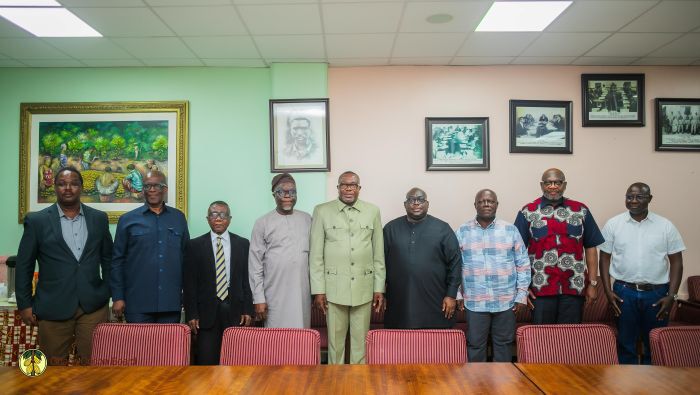
COCOBOD has unveiled three new sub‑committees to enhance transparency, accountability and sustainability within the cocoa industry.
The inauguration, held at COCOBOD headquarters in Accra on 21st October, was led by Board Chairman Dr. Samuel Ofosu‑Ampofo and attended by board members, senior management and staff.
The three committees are the Finance Committee,The Cocoa Tertiary Education Trust and Schorlarship Committee and The Cocoa Sector Marketing Commitee.
According to Dr. Ofosu-Ampofo, the President upon assuming office, constituted this new Board with a clear mandate to chart a new course for the revival and transformation of Ghana’s cocoa sector.
The Finance Committee, Chaired by Mr Thomas Ampem Nyark – Deputy Minister of Finance, is tasked with strengthening fiscal discipline across COCOBOD’s operations. This is especially given a reported debt stock of approximately GHS 32 billion.
The Cocoa Tertiary Education Trust and Scholarship Committee is chaired by Dr Johnson Asiama, the governor of Bank of Ghana. The committee is charged with managing the newly‑created Cocoa Tertiary Education Trust Fund. This initiative will support tertiary education, vocational training and capacity building for children of cocoa farmers and sector workers.
The Cocoa Sector Marketing Committee (COSMARC) as Chaired by Mr Sampson Ahi, MP for Bodi is also tasked with reviewing performance of Licensed Buying Companies (LBCs), assessing market trends and recommending policies to safeguard equity, transparency and sustainability throughout the cocoa value chain.
In his address, Dr Ofosu‑Ampofo noted that the inauguration signals COCOBOD’s renewed commitment to realign the cocoa sector with the Government’s “Reset Agenda”. He emphasised that restoring discipline, efficiency and sustainability in the industry is now more urgent than ever.
Given the significant financial challenge that COCOBOD faces, the Finance Committee will play a significant role in restoring public confidence and guiding the Board toward financial stability and growth.
Meanwhile, the Education‑Trust committee’s focus emphasizes the importance of investing in the next generation of cocoa sector professionals and ensuring that farmers’ children are equipped to contribute meaningfully to the industry’s future.
The Marketing Committee (COSMARC) is also expected to address longstanding issues such as irregular cocoa purchasing, smuggling, and unfair market practices which have undermined the sector’s integrity. The committee’s work is described as vital for maintaining Ghana’s reputation as a global leader in quality cocoa.
For cocoa farmers, these developments could translate into benefits such as improved reliability of payments and strengthening of the overall value chain, greater access to scholarships or vocational training for children of farmers and better monitoring of marketing, purchasing systems and LBC performance which may help reduce unfair practices. Thus, improve farmers’ negotiating power and fairness in trade.
COCOBOD’s Chief Executive, Dr Randy Abbey, reaffirmed management’s support for the committees. He also indicated that their formation is a major milestone in the broader transformation agenda for the cocoa economy.
Chairpersons of the three committees pledged to serve diligently and collaboratively. They also committed themselves to the values of transparency, integrity and accountability.
As COCOBOD implements this governance enhancement, stakeholders across the cocoa value chain will be watching closely to see how these structures turn into measurable improvements in efficiency, fairness and sustainability.
Story By: Caris Adjei London
