

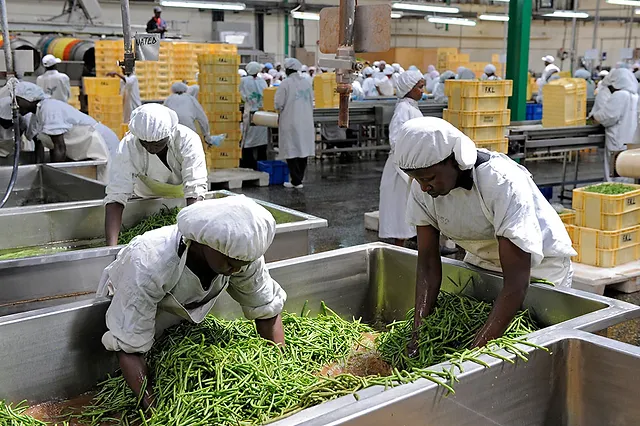
A new report on Ghana’s agricultural sector has triggered reactions among concerned Ghanaians and others on the need to redefine the food security agenda on the African continent.
There are several calls among the reactions to the report saying governments should collaborate with the private sector to invest in agro-processing rather than usually campaigning more for production when the likelihood that these food products will end up in the trash is very high.
The new report by the Danish Embassy in Ghana said the post-harvest loss in the country amounts to a whopping $1.9 billion per annum, a sad development many concerned people are not happy about.
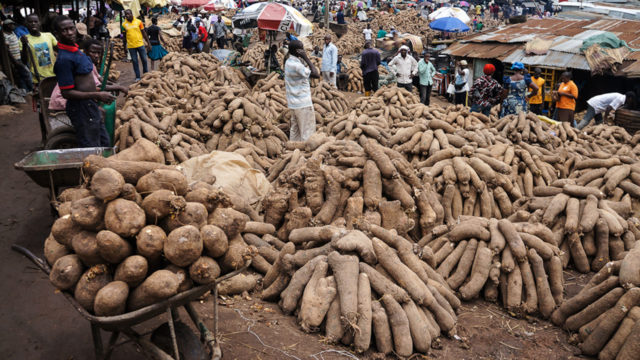
Shockingly, the post-harvest loss for yam, a highly consumed staple in Ghana and across the world is $560 million annually out of the six crops the research focused on.
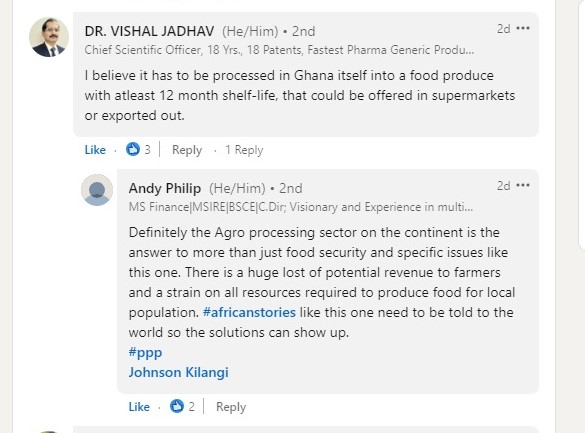
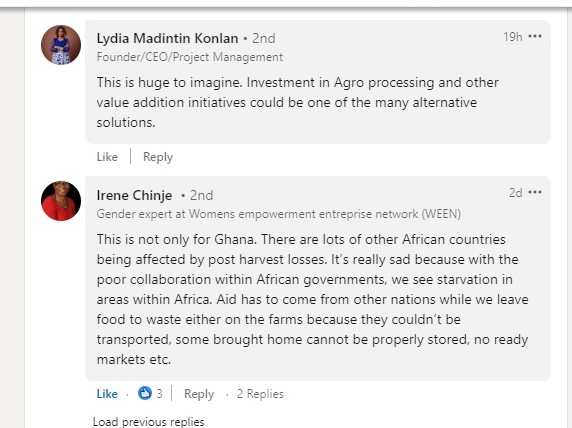
Sadly, the high volumes of food waste is not a Ghanaian problem alone. There are several African countries that also suffer from the situation.
The Lead Researcher of the study, Dan Acquaye while presenting the findings at a seminar organised by the Danish Embassy, stated that “after the research, we realised that if you take tomato, yam, mango, citrus, and chilies with the areas that we performed the analysis, the food losses was about $1.9 billion per annum”.
“We were surprised that the food loss of yam was over $560 million per annum”.
Mr. Acquaye also disclosed that the post-harvest loss of mango was about $300 million while tomatoes alone accounting for over $60 million per annum.
The report also came on the back of March 12, which marks the day of Sustainable Development Goal 12.3, which aims to drastically reduce food losses along production and supply chains.
Meanwhile, the Danish Ambassador to Ghana, Tom Norring reiterated that it is significant to form partnerships in finding solutions to challenges facing the agricultural sector in Ghana.
“Denmark is actually traditionally a farming country, hence we’ve developed a lot of solutions of which some will be applicable here and others need to be adopted to be applicable in Ghana”.
“We have companies that developed solutions for food losses such as providing cold storage, cold chain among others. We want to bring in some Danish companies to match with some Ghanaian companies to form partnerships. We believe that these kinds of partnerships create real ownership on both sides,” he stated.
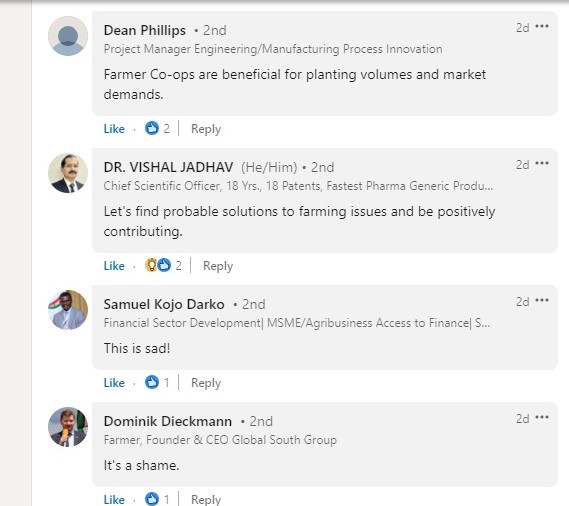
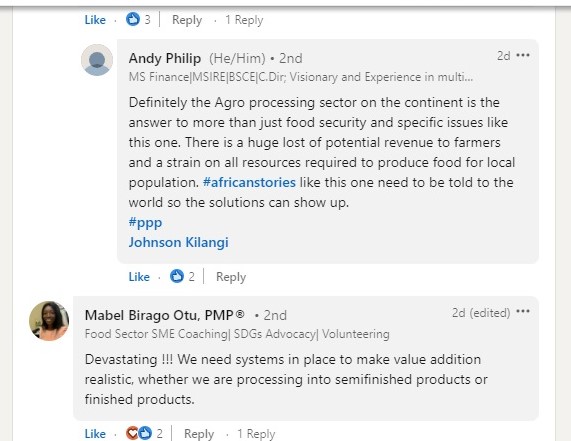
Below are more screenshots of comments from LinkedIn
How best can Africa deal with post-harvest loss on the continent? Share you views with us.
