


When she could not bear the losses that came with her fresh tomatoes business, she resorted to plantain selling and distribution in the Ashaiman and Tema Community One markets in the Greater Accra Region of Ghana.
Mary Gyamfia, a trader, saw how attractive the business became five years ago when the consumption of plantain went beyond traditional fufu-making to include other well-packaged ready-made foods such as plantain chips.
Gyamfia’s business grew just as many other fresh plantain traders over the years because of the increase in the processing of the raw materials into chips and powder and the rise in the activities of roasted plantain vendors, a popular street food loved by locals and foreigners.
The love for other street foods such as kelewele, spicy fried plantain, kaklo, made from overripe mashed-spiced plantain balls, boiled beans and gari nicknamed, red-red, yorke gari or gob3, paired with fried ripe plantain leaves, room for minimal waste resulting in the reduction of post-harvest losses.
“I used to sell tomatoes, but I incurred so many losses due to the short life span and also poor handling during transportation.”
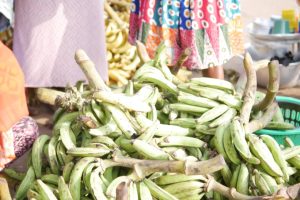
“The plantain business is far better than the tomatoes. When I started, I shared space with other traders to get a truck full, but I’m now able to buy a truck full of plantains alone to distribute to my customers,” Gyamfia revealed.
Even though the business has been profitable for Gyamfia, its growth has not been encouraging due to fluctuating fuel prices leading to high costs of transportation.
“Whether plantains are in season or not, the drivers charge according to fuel prices. Another issue is the high cost of oil. As a result, chips producers are unable to buy plantains in large quantities as they used to,” Gyamfia emphasised.
These sellers who travel hundreds of kilometres to source plantains to supply their customers currently compete with other traders from neighboring countries like Togo, Côte D’Ivoire and Burkina Faso as the farmers claim they offer better pricing, says Augustina Avinu another trader who used to run a local restaurant commonly known in Ghana as ‘chopbar’.
“The government should consider regulating fuel prices, which would ease transportation costs for us and help plantain chips producers who are struggling with high oil prices. This is slowing the business growth.”
Agness Bekoe is a small-scale plantain chips producer whose target market are Ghanaians travelling abroad and students.
She packages her products in eco-friendly paper pouches and distributes them to students on university campuses at a reduced price to resell in their various hostels and lecture break times.
“Because of the airtight paper pouches I use to package it, people travelling abroad buy it a lot, and this was a result of recommendations from friends and customers. This is what has kept the business moving,” Bekoe narrated.
She corroborated Gyamfia and Avinu’s submission on how costly fresh plantains and oil are lately.
Bekoe buys fresh plantains from Agbogbloshie, one of the largest food markets in the heart of Accra, at cheaper prices.
She believes post-harvest losses in the markets are still an issue because of the high cost of plantains.
“Price increments are regular even in the peak season, so even if you’re willing to buy more to process, the capital is not enough. It’s disappointing to see heaps of overripe plantains when they could have been sold in their fresh states.”
Charity Adupong, a Food Processing Entrepreneur and the Founder of Meannan Foods, is a commercial producer of plantain chips and flour in Afienya, Ningo-Prampram District of the Greater Accra Region.

Passionate about making indigenous foods attractive for anyone to want to try them, she added plantain processing to her range of products.
Adupong believes the food processing and preservation industry in Ghana has not reached its peak, and so the influx of noodles is infiltrating the system, such that “most children don’t even want to eat our indigenous foods, and it’s also due to the fact that the preparation of these foods takes longer to cook.”
“Ghana fufu is mostly made from plantain and cassava. We all love our fufu, but it takes a lot of time to make, and these are the reasons we need to process our foods to make it easy for people to eat while preserving traditional recipes, and so this is what inspired me to start processing plantain,” she said.
Meannan plantain chips was also born to address the post-harvest losses suppliers experience.
“Sometimes you order plantain from the farmers or market queens, and in the process of transportation, things do not go your way. It is not as fresh as you want it, so we decided that instead of returning it to the farmer, we have to find something else to do with it, and that’s how we also started our plantain chips production.”
“My love for roasted plantains and peanuts also influenced me to give the Meannan plantain chips a twist by adding coated fried peanuts, which makes them different from the regular ones on the market,” Adupong added.
Due to the enzymic features of plantains, which affect the final products, Meannan Foods invested in modern machines, including an electric slicer, blancher and dryer, to maintain the natural taste of plantain to keep this part of her business afloat.
Meannan Foods produces about 50 metric tons of plantains during both the peak and lean seasons in Ghana, and about 80 to 90 per cent of the products are sold here, and the rest for export.
“Part of the work I’m now doing with the Food Research Institute and some other organisations is to find ways of having plantains all year round, with which we will be able to process more,” Adupong narrated.
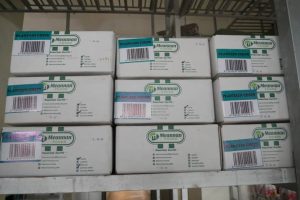
Her company profiles the smallholder farmers to give them a ready market, which is also helping to address post-harvest losses.
“With the kind of work we do, when plantain is in season, we do not have too much waste as was the case a few years ago. Plantain is seasonal, so if we do not take advantage of processing to extend the shelf life, then we’re doomed,” she stated.
The primary individuals whose business affects the value chain are the farmers.
The success of their business is dependent on the growth of processors in the cities where consumption of plantain is high.
Kwame Antwi Boasiako, a farmer and marketer, owns 20 acres of plantain farm in Asamankese in the Eastern Region of Ghana.
He believes there’s a high demand for the starchy tropical fruit. However, the farmers are at a disadvantage due to poor pricing from the market women.
“Farmers need to understand marketing and plant accordingly. Planting monthly gives a better assurance of profit-making by harvesting all year round. The demand is there, and I have people I supply to in the cities.”
As the plantain food itself presents vast opportunities for entrepreneurs, so do the other by-products, such as the peels, leaves and stem.

Innovation and entrepreneurship driven companies like Kodu Technology, producers of biodegradable plantain stem-based sanitary pads in Tamale, the Northern Region of Ghana and Mending Papers, in Tarkwa in the Western Region known for producing eco-friendly paper bags in large quantities using plantain trees, rice straw and maize husk are already creating jobs using what usually becomes a waste.
These innovations, an Agribusiness Strategist, Kojo Akoto Boateng, says need proper attention not only to address unemployment but also climate change by creating an industry out of the whole tree to replace single-use plastics and other products in the ecosystem.
“If we had a well-organised plantain market, we could aggregate plantains as well as the peels for animal feed production, while the leaves can be used for food packaging instead of using plastics to wrap hot foods.”
“Once you harvest plantain and banana, the plant becomes waste apart from the suckers that grow around the mother. The stem also presents a big opportunity for us to do proper mulching instead of using plastic. It contains a lot of moisture and delivers more moisture to the plants and decomposes to add more nutrients to the soil,” Boateng disclosed.
The impact of investments in processing plantain and its by-products into value-added extends beyond providing farmers with a reliable income, but also empowers communities. From crispy plantain chips to biodegradable sanitary pads and eco-friendly paper bags, the industry is a recipe for economic growth and a healthier planet.
This work was made possible through the support of the #AfricaNoFilter, a sponsored project of Rockefeller Philanthropy Advisors.
By: Sefakor Fekpe
