

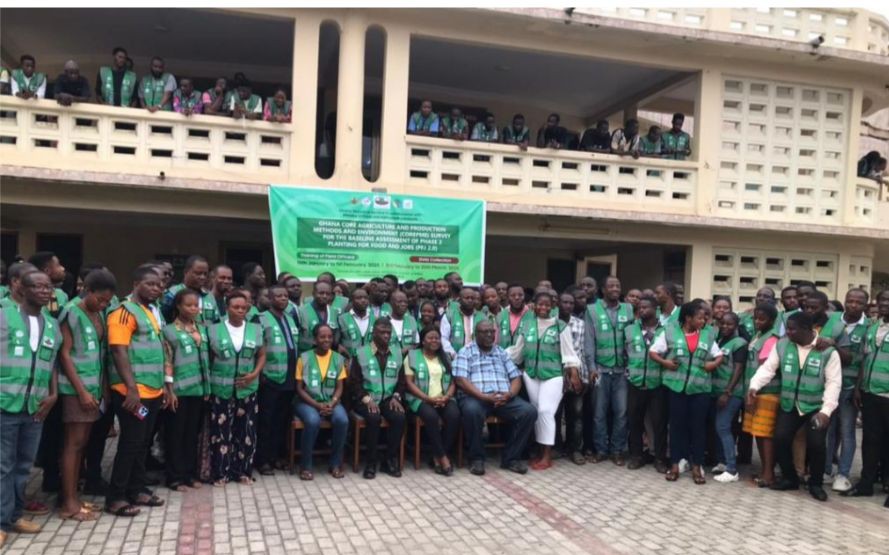
The Ghana Statistical Service (GSS), in collaboration with the Ministry of Food and Agriculture (MOFA), has officially commenced a survey to evaluate Phase 2 of the Planting for Food and Jobs (PFJ) initiative.
The Ghana Core Agriculture and Production Methods and Environment (CorePME) survey, which forms part of the wider Ghana Core Agriculture Surveys (GCAS++), aims to collect vital data that will facilitate informed decision-making within the agricultural sector, ensuring sustainable growth and development.
Fieldwork for the survey is set to start from 3rd February to 20th March 2025, employing Computer-Assisted Personal Interviews (CAPI) to enhance the efficiency and accuracy of data collection.
Edward Asuo Afram, Acting Deputy Government Statistician for Economic Statistics and Data Science, remarked that the survey is designed to furnish reliable and current information on agricultural production and farming practices. This data will underpin evidence-based policymaking, bolster food security, and foster sustainable agricultural practices.
Additionally, the survey will contribute to the baseline impact assessment of Phase 2 of the PFJ initiative and supply data for Sustainable Development Goal (SDG) 2.4.1, which gauges the proportion of agricultural areas under productive and sustainable practices that bolster resilience to climate shocks.
Mr Asuo Afram highlighted that the primary aim of the survey is to generate dependable benchmark data for the agricultural sector, address existing data gaps, and facilitate evidence-based decision-making. He stated, “It will assess the impact of PFJ 2.0 while providing insights into the environmental, social, and economic sustainability of farming practices. Furthermore, it will contribute to greenhouse gas (GHG) emission calculations related to agriculture.”
The CorePME survey will produce official statistics for both household and non-household farms, ensuring high-quality agricultural data for policy development. It will estimate production levels for crops, vegetables, livestock, fish, aquaculture, forestry, and bushmeat consumption while also examining the use of inputs such as labour, irrigation, and fertilisers. The survey will further assess farming practices concerning soil health and pollination.
Detailed estimates of crop, vegetable, and livestock production will be compiled by type and region. The survey will also evaluate fish and aquaculture productivity by type and location, alongside data on the consumption and sale of bushmeat, forestry products, and utility poles. It will investigate the impacts of deforestation and afforestation, ascertain the utilisation of essential agricultural inputs, and analyse farm practices related to soil health and pollination methods.
Mr. Asuo Afram noted that 220 trained field officers will be dispatched to gather data from agricultural households and institutions across selected Enumeration Areas (EAs) nationwide. “The findings from this survey will provide critical insights for policymakers and programme developers to support farmers and agribusinesses. Moreover, the survey will assist in tracking Ghana’s progress towards the Medium-Term Development Framework and Sustainable Development Goals (SDGs), particularly about 12 out of the 17 SDGs,” he added.
Reporting by Stephen Freeman, Accra.
