

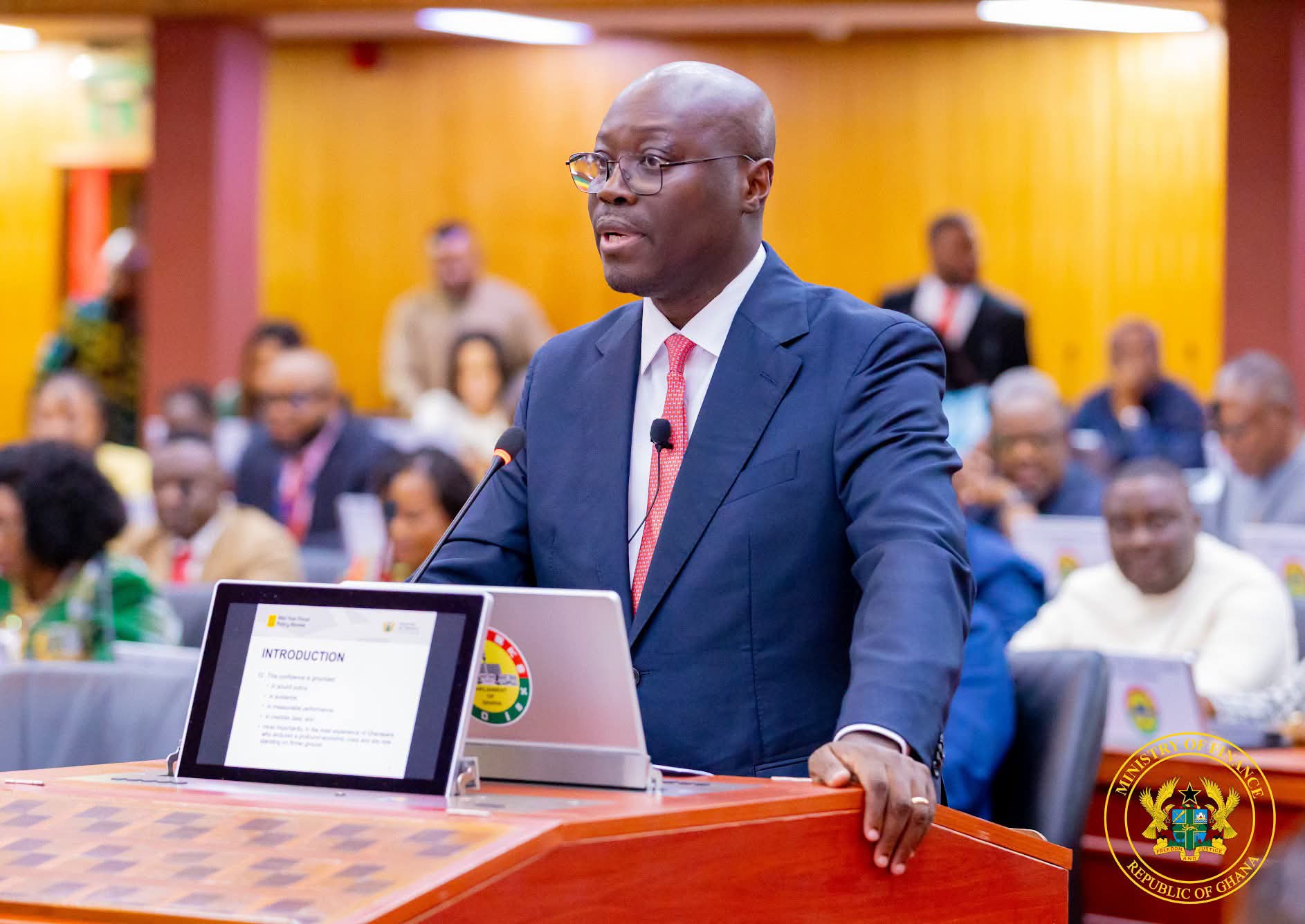
The Minister of Finance, Dr Cassiel Ato Forson, has said that the government remains committed to transforming Ghana’s oil palm industry into a major driver of industrialisation, export growth, import substitution and rural employment.
He said that a key pillar of the Integrated Oil Palm Development Policy is the establishment of sustainability-compliant oil palm land banks to de-risk private sector investment and accelerate the development of large-scale plantations integrated with smallholder and outgrower schemes.
Implementation of this initiative is progressing steadily, he said.
Presenting the 2026 Mid-Year budget statement in Parliament on Thursday, July 23, he said the Ministry of Lands and Natural Resources, working in collaboration with the private sector and other relevant institutions, has reviewed over 270,000 hectares of land in the Western Region for this purpose.
Drone surveys have been completed on over 117,000 hectares, while 46,000 hectares have been selected for detailed Land Use Change Analysis, he added.
To date, he said, an assessment has been completed on 16,000 hectares, of which approximately 10,780 hectares have been identified as suitable for sustainable oil palm development.
“These areas are now undergoing the required environmental, social and sustainability assessments, including High Conservation Value, High Carbon Stock, and Free, Prior and Informed Consent (FPIC) processes, in line with international standards. Similar mapping and land documentation activities have commenced in the Central Region, with preparatory work underway in the Eastern and Volta Regions.
“Based on current assessments, the Western Region alone is expected to provide approximately
30,000 hectares of land for the first phase of development,” he said.
As work expands nationwide, he added, the land bank has the potential to exceed 100,000 hectares across Ghana’s oil palm growing belt. This initiative will unlock significant private sector investment, create over 250,000 direct and indirect jobs across the value chain, strengthen smallholder participation, increase domestic crude palm oil production, reduce import dependence and position Ghana as a leading regional hub for palm oil processing and exports, he said.
“Government will continue to work with all stakeholders to ensure that this programme is implemented responsibly, sustainably and in a manner that delivers lasting benefits to our communities and the national economy.”
“Government is also finalising a US$500 million Integrated Oil Palm Development financing agreement with the World Bank for on-lending to the private sector for the development of large-scale commercial oil palm plantations. We expect to conclude and present it to the House by the end of 2026,” the Minister said.
Story by Kofi Nartey
