

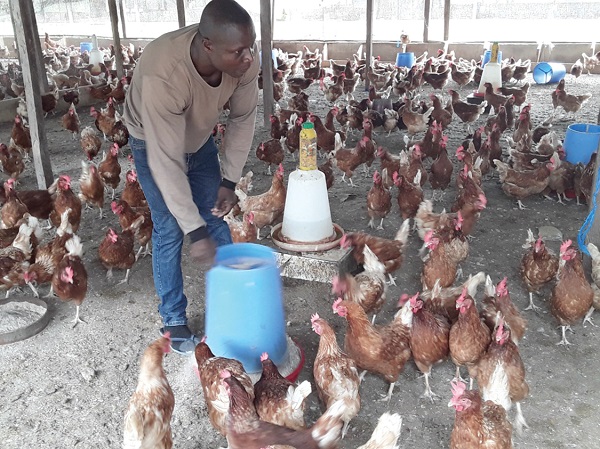
The 24-Hour Economy and Accelerated Export Development Secretariat announced a major step Ghana is taking to reduce its long-standing dependence on imported poultry after signing a Heads of Terms agreement for a US$270 million integrated poultry investment under the National Poultry Transformation Programme.
Successive governments undertook several investments to boost local production but failed to yield the needed results as the country continues to spend an estimated $300–$350 million annually on chicken imports.
The new agreement, convened by the 24-Hour Economy and Accelerated Export Development Secretariat, brings together Agrium Capital, Petra Pension Trust and Axis Pension Trust, with Ghana EXIM Bank expected to join, to develop a full-scale poultry value chain spanning feed production, breeding, processing, cold storage, logistics and market access.
Ghana imports roughly 250,000–300,000 metric tonnes of poultry products each year, far exceeding domestic output and underscoring the urgency of reforms in the sector.
Successive government interventions, including the Nkoko Nkitinkiti initiative and broader investments in agriculture, have sought to revive local production, but gaps in financing, input supply and processing infrastructure have persisted.
Following the announcement, there have been concerns pointing to a critical gap that must be addressed if the US$270 million poultry investment is to deliver inclusive growth.
For many observers, the success of the initiative will not be measured by the scale of infrastructure or capital deployed, but by how effectively smallholder farmers are integrated into the value chain. In the absence of deliberate policies to ensure affordable feed, access to low-interest financing, and structured off-take agreements with processors, small-scale poultry producers risk being sidelined in favour of large commercial operations.
The disparity in borrowing costs, where local farmers face interest rates above 15% compared to single-digit rates for foreign competitors, further weakens their ability to compete, even in a high-demand market.
Ultimately, stakeholders argue that demand alone is not enough to transform the sector. While Ghana’s strong appetite for poultry products signals clear market potential, the high cost of production, particularly feed and financing, continues to erode profitability for local farmers.
For the investment to truly disrupt imports and strengthen domestic production, it must go beyond capital injection to include targeted support systems that improve farm-level efficiency, guarantee stable pricing, and create reliable market linkages.
Otherwise, there is a real risk that the initiative could expand the industry on paper while leaving the average Ghanaian poultry farmer struggling to survive within it.
New Agreement Aligns With 24-Economy
The new investment is also aligned with the government’s flagship 24-hour economy initiative, a policy designed to drive round-the-clock productivity across key sectors such as agriculture, manufacturing and services. The programme seeks to boost production, create jobs and shift Ghana from exporting raw materials to value-added goods, while encouraging businesses to operate in multiple shifts to maximise output and competitiveness.
Backed by new legislation establishing a dedicated authority to coordinate implementation, the initiative is being rolled out as a central pillar of Ghana’s economic transformation agenda, with targeted support for agribusiness, export development and industrialisation.
The poultry project, once finalised into a shareholders’ agreement, will help close supply gaps, reduce imports and anchor a more resilient, locally driven poultry industry under the 24-hour economy framework, the 24-hour Economy and Accelerated Export Development Secretariat says on its official Facebook page.
