

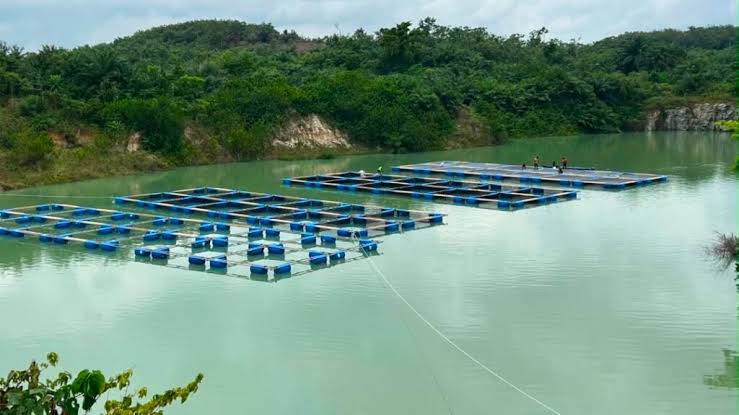
The Ministry for Fisheries and Aquaculture has announced plans to utilise abandoned clay and quarry pits by converting them into fish farms.
The sector Minister, Emelia Arthur, while launching the project in the Shama Municipality of the Western Region, said this innovation will serve as a source of livelihoods for the locals.
Known as the Komfueku-Shama Aquaculture Project, it is being piloted in partnership with R&B Farms. It aims to promote sustainable fisheries by converting abandoned and underutilised lands into productive fish farms, thereby boosting food production, creating jobs, generating income, and strengthening local communities.
While addressing a gathering in Komfueku, Madam Arthur said Ghana’s fisheries sector faced growing challenges, including pressure on marine resources and the impacts of climate change, making it necessary for stakeholders to diversify livelihoods and expand fish production through sustainable aquaculture practices.
“What excites me most about this project is its potential for replication because, across Ghana, there are many abandoned excavated sites that could be converted into productive aquaculture enterprises,” she said.
She stated that aquaculture offers significant potential for Ghana to boost fish supply, minimise imports, generate employment, and improve food security.
The Minister added that the Komfueku-Shama Aquaculture Project would support these national goals while advancing environmental restoration and responsible land use.
“If successful, the Komfueku-Shama model can serve as a blueprint for sustainable aquaculture development in other parts of the country.”
Madam Arthur commended R&B Farms for developing the project and investment in the pioneering initiative, noting that the company’s commitment underscores the vital role the private sector must play in driving innovation and growth in Ghana’s aquaculture industry.
She also assured stakeholders that the Ministry of Fisheries and Aquaculture remains committed to supporting responsible investments that boost fish production, create jobs, and advance Ghana’s Blue Economy agenda.
Mr Benjamin Turkson, Co-Founder of R&B Farms, said that following a successful pilot phase, the project would be expanded to communities such as Anto, Supomu-Dunkwa, and Daboase Junction, where several abandoned pits are located.
“Apart from converting these abandoned pits, which have become death traps, our major objective is to create jobs for the youth and women through our innovative fish farming initiative,” he said.
Mr Turkson further urged the government to leverage aquaculture to address unemployment and curb illegal mining (galamsey) activities across the country.
In a speech read on his behalf, Western Regional Minister Mr Joseph Nelson said the project aligns with the government’s efforts to promote sustainable aquaculture, enhance food security, drive economic empowerment, and ensure environmental stewardship.
He called on traditional authorities and Metropolitan, Municipal and District Assemblies (MMDAs) in the region to embrace the initiative and transform abandoned pits into productive ventures that would stimulate local economic growth.
