

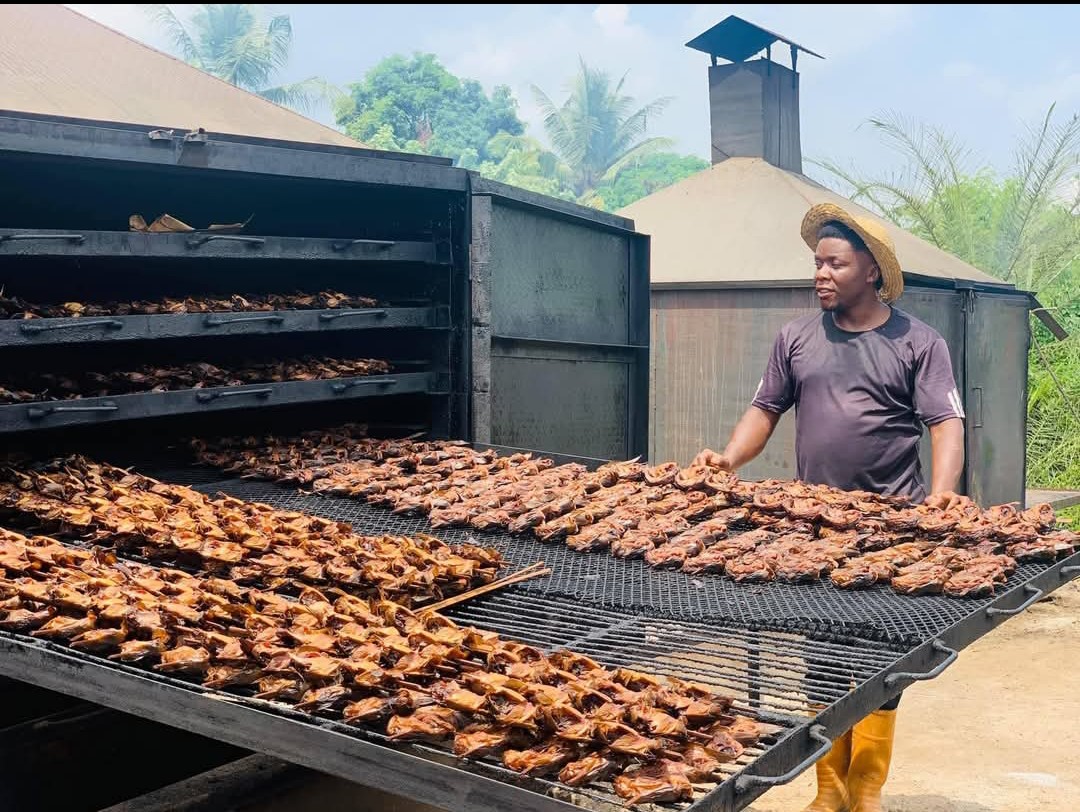
In Akure the largest city in Ondo State, smoke rises gently from a huge metallic kiln behind a modest fish farm. It curls into the sky like a quiet signal of industry, discipline, and purpose. Workers in the early hours inspect the ponds and feed the fish.
That smoke and ponds carry a story that has travelled from a small riverine village to digital screens across West Africa, inspiring a new generation of catfish farmers, including many in Ghana.
For Yinyegha Tiki, catfish is more than a business. It is heritage, survival, and innovation woven into one journey.
He learned the craft as a young boy, standing beside his mother as she smoked fish using traditional methods. What began as a childhood routine became a lifelong skill, one he would later refine, modernise, and turn into a thriving enterprise.
Today, through Tikifish Farm & Smokehouse, Tiki processes catfish from his own ponds, buys from fellow farmers, and even sources wild river fish to meet the diverse tastes of his customers both locally and internationally.

But what truly sets him apart is not just the fish. It is how he tells his story.
On social media, Tiki does something many farmers shy away from: he opens his books. He breaks down his costs, explains his pricing, and shows every investment decision. Followers don’t just watch, they learn. They question, engage, and replicate. In a region where agricultural knowledge is often guarded or informal, Tiki has turned transparency into a powerful teaching tool.
For catfish farmers in Ghana, especially young agripreneurs navigating rising feed costs and market uncertainty, this model is quietly revolutionary. It shows that farming is not guesswork; it is strategy, numbers, and storytelling combined.

Back on his farm, the ecosystem reflects the same thinking. Plantains and other crops grow alongside fish ponds, creating a diversified system that maximises land use and reduces risk. It is not just a farm, it is a living classroom. University students and graduates come to train under him, gaining hands-on experience in aquaculture, processing, and agribusiness management.

Yet, no matter how far his work travels, Tiki remains rooted in Arogbo also in Ondo State, the village he calls the foundation of everything he has built.
There, he has invested in a smokehouse managed by his sister, creating jobs and strengthening the local economy. The tools he uses skewers, raffia, and other materials, are sourced and crafted locally, tying his modern business back to indigenous knowledge systems.
Nigeria is the world’s largest producer of African catfish, with about 285,000 producers, says the Food and Agriculture Organisation, most of them small-scale farmers like Tiki. Together, they employ roughly a million people, feeding a nation where catfish is a staple in both fresh and smoked forms. But within these numbers are individuals whose stories shape the future of the industry.
Tiki is one of them.
“Every smoked catfish you see… carries a deeper story,” he once shared on his verified Facebook page.
For Ghanaian catfish farmers watching from across the border, his journey offers something rare: proof that success in agriculture today is not just about production. It is about visibility, value addition, and community.
It is about turning a simple fish into a movement.
And in the rising smoke from his kiln, many are beginning to see different perspectives of agribusiness.
