Ghana-based food processing companies in pepper processing have come under scrutiny over their sourcing preferences after revelations that the products are made using imported raw materials rather than locally grown chilli peppers.
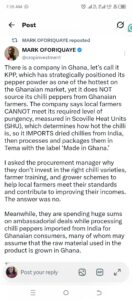
According to a farmer and social impact industrialist, Mark Oforiquaye, one of the companies positions its product as one of the hottest pepper powders on the Ghanaian market, emphasising its pungency level measured in Scoville Heat Units (SHU)—the global standard used to determine chilli heat intensity. Despite the “Made in Ghana” label on its packaging, the firm allegedly imports dried chillies from India to meet its production specifications.
According to a post Oforiquaye made on X, generating several discussions, the company, whose name he disclosed as KPP, maintains that Ghanaian farmers are currently unable to supply chilli varieties that meet its required SHU levels. This, the company claims, necessitates relying on raw materials externally before processing and packaging them in Tema for the local market.
The development has sparked debate among agribusiness stakeholders and observers, with questions being raised about why more effort is not being directed toward strengthening domestic supply chains instead of relying on imports.
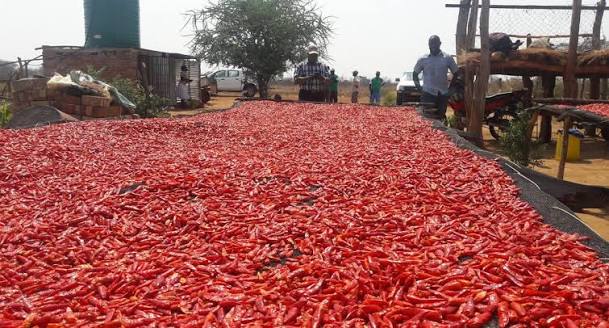
In recent times, local chilli pepper farmers have experienced a glut, leaving their investments locked up. Some old stocks from 2024/2025 farming seasons are still unsold.
Oforiquaye said he engaged a procurement manager on whether the company had considered investing in improved chilli varieties, farmer training, or structured outgrower schemes to help bridge the gap; the response was said to be negative.
“I asked the procurement manager why they don’t invest in the right chilli varieties, farmer training, and grower schemes to help local farmers meet their standards and contribute to improving their incomes. The answer was no,” parts of his post read.
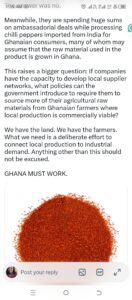
“Meanwhile, they are spending huge sums on ambassadorial deals while processing chilli peppers imported from India for Ghanaian consumers, many of whom may assume that the raw material used in the product is grown in Ghana,” Oforiquaye raises a concern.
His posts on the company’s position have drawn concern from sections of the agricultural community, who argue that Ghana’s farming sector has the capacity to respond to industrial demand if given the right support, investment, and technical guidance.
Critics say the situation shows a broader challenge in Ghana’s agribusiness sector where processors often sideline local production systems in favour of imported inputs, even when the country has suitable land and a large base of smallholder farmers.
The trend, they say, is a disconnect between industrial demand and local production capacity, adding that importing and repackaging weakens the link between farmers and industry.
Stephanie @BibiniBea expresses concern, saying, “I think this is problematic because they are changing our appetite to a taste that isn’t local and will need an import to support it.”
The issue also raises questions about labelling and consumer perception, particularly when products packaged locally carry “Made in Ghana” branding despite relying heavily on imported agricultural inputs. Others also argue for the need for transparency to ensure that labelling accurately reflects sourcing practices.
Oforiquaye’s post reignited calls for stronger local content frameworks in agriculture and agro-processing, urging the government to consider measures that push companies to source a significant portion of their raw materials locally, where viable production conditions exist.
“If companies have the capacity to develop local supplier networks, what policies can the government introduce to require them to source more of their agricultural raw materials from Ghanaian farmers where local production is commercially viable?” He asks.
Such policies could help stimulate investment in the ecosystem like seed systems, extension services, irrigation, and structured farmer-outgrower schemes, particularly for high-value crops like chilli peppers.
“We have the land. We have the farmers,” he says. “What we need is a deliberate effort to connect local production to industrial demand. Anything other than this should not be excused.”
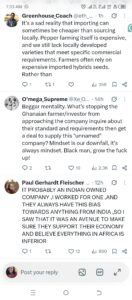
Meanwhile, other X users who interacted with the post caution that quality consistency, supply reliability, and processing standards remain key constraints that must be addressed in order to push a strong point for strict local sourcing.
Ghana continues to position itself as a regional agro-processing hub. The conversations over imported inputs versus local sourcing are likely to grow, especially in value chains where the country already has production potential.
Mark Oforiquaye’s post about pepper powder has become a focal point in the wider conversation about how Ghana can better connect its farmers to its growing agro-industrial sector, and whether “Made in Ghana” should mean more than just where a product is packaged.
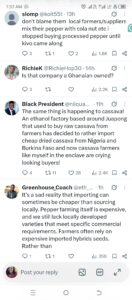
Cassava is also suffering the same thing as some farmers in areas where there are factories producing ethanol are alleging that the companies have neglected the farmers and are importing dried cassava chips from Burkina Faso, Togo, Nigeria, among others.
Below are some screenshots of the conversations under Mark Oforiquaye’s post on X.