

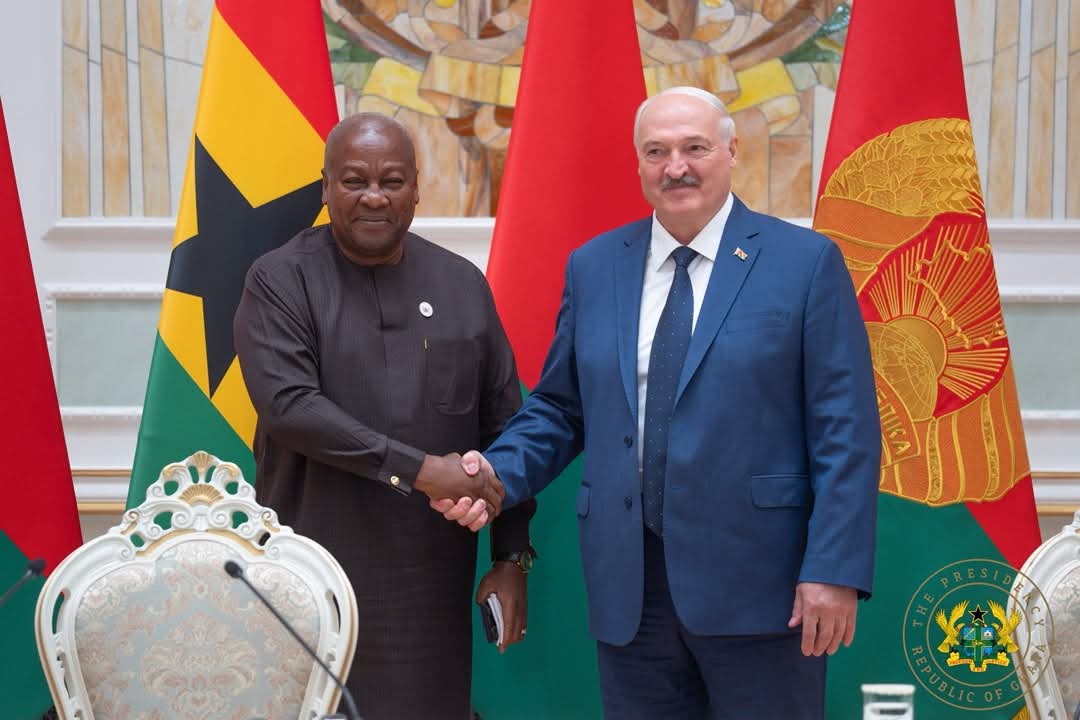
President John Dramani Mahama has secured a deal with Belarus for the supply of 1,840 pieces of agricultural equipment to equip a nationwide network of farmers service centres as part of the Feed Ghana Program aimed at transforming access to mechanised farming.
The centres are expected to provide shared machinery and technical support to farmers, reducing costs and increasing efficiency in agricultural production.
Speaking at the Belarus-Ghana Business Forum in Minsk, President Mahama said the agreement reflects a shift from diplomacy to practical economic collaboration.
“We are gathered here not merely to exchange ideas but to create opportunities, to forge partnerships and to lay the foundations for a new chapter in Ghana-Belarus cooperation,” he stated.
He emphasised that agriculture remains the most immediate area for impactful cooperation, particularly in mechanisation and value addition.
According to him, Ghana and Belarus are well-positioned to work together, as the two economies are “highly complementary”, combining Belarus’ industrial strengths with Ghana’s market potential and political stability.
The President also used the platform to highlight Ghana’s economic recovery, citing improved macroeconomic indicators and increased investor confidence.
“Investor confidence has returned,” he said, noting that GDP had reached $114 billion.
Linking the equipment acquisition to broader national strategy, he said the initiative supports the government’s 24-Hour Economy agenda.
“The programme is encouraging industries to operate around the clock while supporting investments in logistics, energy, transport, manufacturing and agro-processing,” he explained.
President Mahama urged investors to take advantage of Ghana’s agricultural potential.
“Ghana’s fertile land, favourable climate and expanding market make it one of Africa’s most attractive agribusiness destinations,” he added.
He concluded by urging stakeholders to prioritise real-impact driven partnerships.
“The true measure of our relationship should not be the number of diplomatic exchanges that we conduct, it should be the number of businesses that we create, the jobs that we create, the technology that we transfer, and the prosperity we create for future generations,” he said.
