

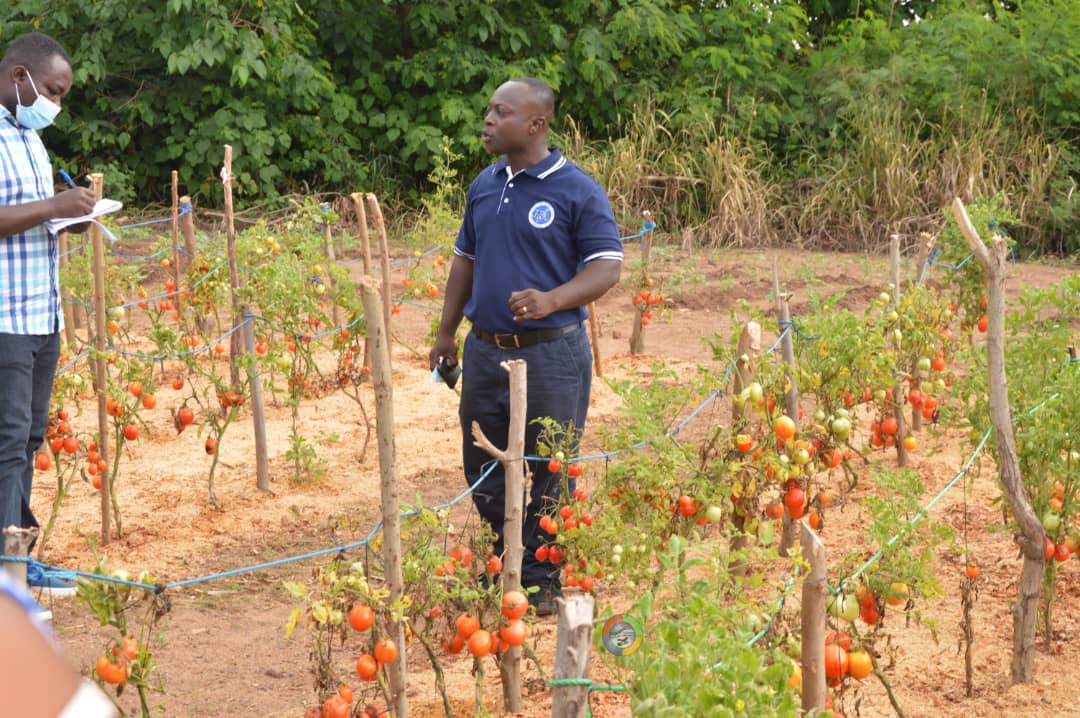
To cut reliance on the external market to meet its seed demands, government is intensifying efforts to transform Ghana’s vegetable seed system through a strengthened partnership with the Council for Scientific and Industrial Research (CSIR).
Speaking at the unveiling of the Ghana Tomato Self-sufficiency Initiative (GHATSI) in Anloga on September 15, the Commodity Lead for Vegetables at the Ministry of Food and Agriculture (MoFA), Esther Agyekum, outlined that the country’s National Production Strategy, 2026–2030, is targeting a significant shift in the tomato value chain to reduce import dependence while increasing the use of locally produced tomatoes by processors from seven per cent to 80 per cent by 2030.
A key pillar of this strategy, she said, is the seed system reform, in collaboration with CSIR and development partners.
She disclosed that MoFA has committed over GH¢6 million to the CSIR–Crop Research Institute (CRI) to support the multiplication and scaling of improved tomato varieties for commercial use.
The investment is aimed at bridging the long-standing gap between research outputs and farmer access to certified seeds.
“Ghana is no longer waiting for another country’s varieties alone. The CSIR-Crop Research Institute has released the CRI Kwabena Kwabena and the CRI Copia, maturing in about 55 days and tolerant to blight,” Agyekum noted.
The two varieties launched in September last year were developed under the Technologies for African Agricultural Transformation (TAAT) programme.
The TAAT programme, started by the African Development Bank (ADB) in 2018, aimed at catalysing agricultural growth, improving food security, and promoting inclusive growth across Africa.
The Gh¢6 million investment in the new varieties is to help multiply and distribute them at scale under a national seed deployment framework, with support from research institutions, seed companies, and development partners.
She emphasised that strengthening seed systems is central to addressing Ghana’s structural production challenges, particularly in the tomato sector where output has remained below demand levels for years.
“You cannot irrigate your way out of a seed problem. You can finance a farmer, insure the farm, and guarantee the market—but if the seed is weak, recycled, or disease-prone, then what you have done is simply finance a poor harvest,” she added.
While presenting government data at the engagement, Agyekum indicated that between 2020 and 2024, national tomato production has not exceeded 400,000 metric tonnes, creating a significant deficit that is met through imports valued at over $400 million.
The gap, according to her, begins not in production fields but at the earliest stage of the value chain.
“That gap does not begin in the field. It begins with the seed, the seedling, and the nursery,” she stressed.
Farmer Saved Seeds
A nationwide study under the Ghana Seed Partnership, Agyekum said, covering more than 400 farmers across 13 regions, showed that over half of vegetable farmers still rely on farmer-saved seeds, while only about a quarter use hybrid seeds.
Despite this, farmers using improved seeds, she said, achieve significantly higher productivity.
As part of strategies to reduce reliance on imported fresh tomatoes and tomato paste to improve local production capacity, the government is combining seed system reform with irrigation expansion, farmer training, and private sector partnerships, including collaborations with CSIR, the Ghana Seed Partnership, and international development partners such as the Kingdom of the Netherlands.
The broader goal is to transition Ghana’s seed sector “from potential to performance and from dialogue to business.”
“What we have lacked is a system. Today, in Anloga, we are building one: produce at home, feed the nation, export the surplus,” Agyekum concluded.
