

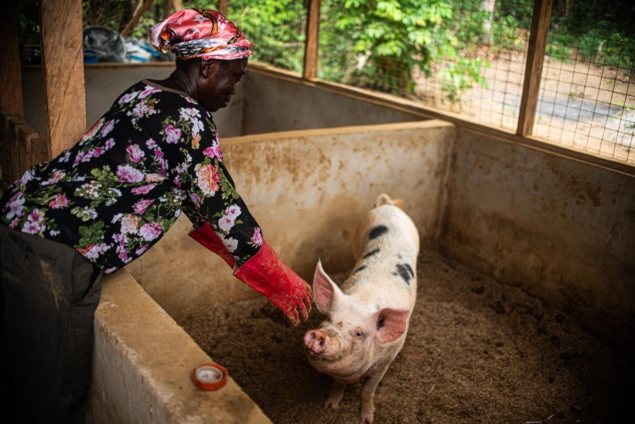
As part of its activities under the EU LEAN project in the high forest ecological zone of Ghana, Rainforest Alliance has trained selected farmers on alternative livelihoods such as pig farming, beekeeping, cabbage farming, snail farming, and others.
Dorcas Amoah, a farmer and beneficiary who also serves as the Vice Chairman of LMB in Sefwi Wiawso and Bopa Community, where Rainforest Alliance is implementing the project dubbed ‘The Landscapes and Environmental Agility across the Nation’ (LEAN), commended the efforts to improve the livelihoods of people in the Western North region.
The LEAN project, funded by the European Union for four years, has an objective to conserve biodiversity, increase climate resilience, and reduce emissions from land use changes in the savannah, high forest, and transition zones of Ghana in addition to helping local farmers improve their livelihoods.
The initiative forms part of plans to improve the farmers’ livelihoods to generate income when their farms are no longer in peak seasons.
Aside from this, it will also educate the participants against causing forest infractions that contribute to deforestation and land degradation while serving as a sustainability tool for the landscape management board.
In an interview, Dorcas Amoah who chose pig farming said, “the activity is very easy. It is very lucrative. I can sell one for as much as 2500GHC and since they breed faster, you’re able to get more pigs in a short amount of time. Besides a lot of people enjoy pork.”
She however stated that feeding was her biggest challenge as a pig farmer.
“Feeding is a challenge, pigs love to eat and their feed is expensive. It is why they are expensive even in this part of town.”
A consortium of four local and international NGOs with expertise in challenging fields, namely Rainforest Alliance, World Vision Ghana, Tropenbos Ghana, and EcoCare Ghana, is responsible for implementing the LEAN project on the ground.
Meanwhile, the project was launched at the national level on May 11, 2021, and subsequently launched in the three targeted areas of implementation.
