Close Menu

    Subscribe to Updates

    Get the latest creative news from FooBar about art, design and business.

    What's Hot

    Eight Million Trees Lost Annually: Stakeholders Demand Bold Action to Sustain Shea Production and Meet Global Demand

    July 31, 2026

    Ghana Spent ¢36bn Importing Frozen Chicken, Rice And Sugar In 2025

    July 31, 2026

    Ghana’s Economy At Risk Without Cocoa Industry Protection — Expert Warns

    July 31, 2026
    Facebook X (Twitter) Instagram
    Facebook X (Twitter) Instagram
    The Ghanaian Farmer
    Subscribe
    • Homepage
    • Agribusiness
    • AgriTech News
    • Livestock
    • Crops
    • Farmer’s Spotlight
    The Ghanaian Farmer
    Home » Ghana Spent ¢36bn Importing Frozen Chicken, Rice And Sugar In 2025
    News

    Ghana Spent ¢36bn Importing Frozen Chicken, Rice And Sugar In 2025

    SefakorBy SefakorJuly 31, 2026No Comments3 Mins Read
    Facebook Twitter Pinterest LinkedIn Tumblr WhatsApp VKontakte Email
    Share
    Facebook Twitter LinkedIn Pinterest Email


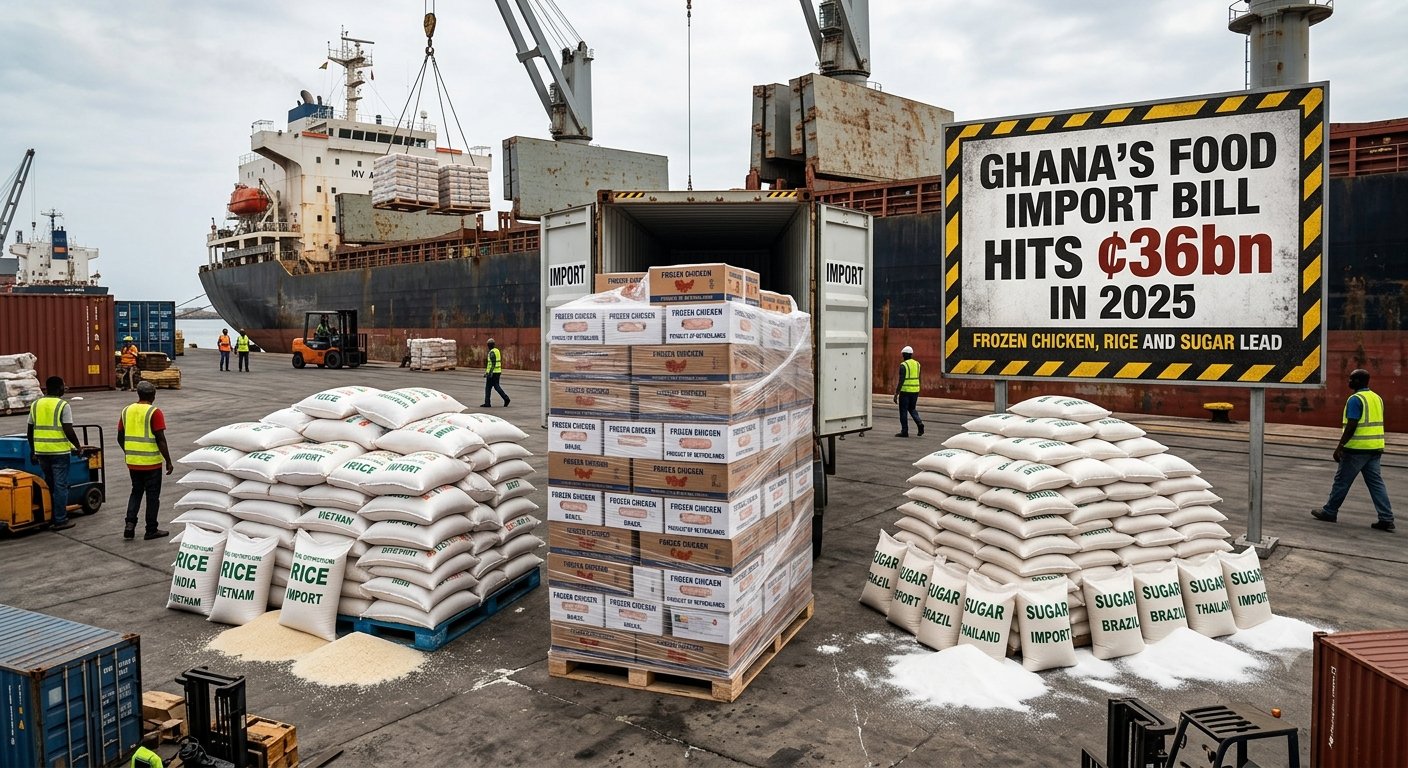
    Ghana’s rising food import bill continues to expose a long-standing disconnect between the country’s agricultural opportunities and its actual output, as new data reveals that more than GH¢36 billion was spent importing key food items in 2025.

    According to the latest Annual International Merchandise Trade Statistics Report by the Ghana Statistical Service, food imports reached GH¢36.46 billion, with cereal grains, frozen chicken, rice and animal products accounting for a significant share.

    Processed cereal grains topped the list at GH¢2.94 billion, representing 8.1 percent of total imports, followed closely by frozen chicken at GH¢2.84 billion and animal products such as guts, bladders and stomachs at GH¢2.72 billion. Rice imports also featured prominently, with semi-milled or wholly milled rice valued at GH¢2.39 billion and broken rice at GH¢1.19 billion.

    Other imports included sugar, frozen fish, palm oil, mangoes and shea nuts—many of which can be produced locally under Ghana’s favourable agro-ecological conditions.

    The figures highlight a persistent challenge: despite decades of agricultural policy interventions, Ghana has struggled to significantly reduce its dependence on imported food. State funded projects such as Planting for Food and Jobs, Rearing for Food and Jobs, and targeted rice and poultry development initiatives were introduced to boost local production and cut imports. The latest national agricultural project, the Feed Ghana Programme also promises to revert the trend. 

    However, these efforts have yielded limited long-term results due to inconsistent implementation, funding constraints, and weak value chain integration.

    For instance, Ghana’s poultry sector has declined steadily, unable to compete with cheaper imported frozen chicken due to high feed costs and limited processing infrastructure. Similarly, rice production has not kept pace with demand, with local farmers constrained by irrigation gaps, post-harvest losses and limited access to finance.

    Attempts to revive the sugar industry with the establishment of the Komenda Sugar Factory have also struggled, leaving the country reliant on imports despite suitable conditions for large-scale sugarcane production.

    Altogether, the four leading imports—processed cereals, frozen chicken, animal products and rice, accounted for 30 percent of the food import bill, underscoring the scale of the challenge.

    While the country continues to record gains in exports of processed cocoa, cashew, tuna and shea-based products, the imbalance between exports and imports reflects structural weaknesses in domestic food systems.

    The report points to the need for stronger investment in agro-processing, improved infrastructure, and consistent policy execution to unlock Ghana’s capacity to produce more of what it consumes and reduce pressure on the economy.


    Share this:

    • Share on Facebook (Opens in new window) Facebook
    • Share on X (Opens in new window) X

    Like this:

    Like Loading...
    Chicken Ghana Food Import Ghana Statistical Service Rice Sugar
    Share. Facebook Twitter Pinterest LinkedIn Tumblr WhatsApp Email
    Previous ArticleGhana’s Economy At Risk Without Cocoa Industry Protection — Expert Warns
    Next Article Eight Million Trees Lost Annually: Stakeholders Demand Bold Action to Sustain Shea Production and Meet Global Demand
    Sefakor
    • Website

    Related Posts

    Eight Million Trees Lost Annually: Stakeholders Demand Bold Action to Sustain Shea Production and Meet Global Demand

    July 31, 2026

    Parliament Approves Cocoa Bill Guaranteeing 70% Returns for Farmers

    July 31, 2026

    Govt Oil Palm Development Under Scrutiny; Economist Demands Clarity On Financing

    July 29, 2026

    FDA Clamps Down On Unsanitary Fish Processors In Tema New Town

    July 28, 2026

    Leave a ReplyCancel reply

    Demo
    Our Picks

    Remember! Bad Habits That Make a Big Impact on Your Lifestyle

    January 13, 2021

    The Right Morning Routine Can Keep You Energized & Happy

    January 13, 2021

    How to Make Perfume Last Longer Than Before

    January 13, 2021

    Stay off Social Media and Still Keep an Online Social Life

    January 13, 2021
    • Facebook
    • Twitter
    • Instagram
    • YouTube
    • LinkedIn
    Don't Miss
    News

    Eight Million Trees Lost Annually: Stakeholders Demand Bold Action to Sustain Shea Production and Meet Global Demand

    By SefakorJuly 31, 20260

    Unless urgent action is taken, global demand for shea products could outstrip supply within the…

    Share this:

    • Share on Facebook (Opens in new window) Facebook
    • Share on X (Opens in new window) X

    Like this:

    Like Loading...

    Ghana Spent ¢36bn Importing Frozen Chicken, Rice And Sugar In 2025

    July 31, 2026

    Ghana’s Economy At Risk Without Cocoa Industry Protection — Expert Warns

    July 31, 2026

    Parliament Approves Cocoa Bill Guaranteeing 70% Returns for Farmers

    July 31, 2026

    Subscribe to Updates

    Get the latest creative news from SmartMag about art & design.

    About Us
    About Us

    The Ghanaian Farmer is Ghana’s leading agricultural news and advocacy platform, dedicated to informing, educating, and inspiring farmers and agribusiness stakeholders. We spotlight innovations, share success stories, and promote sustainable practices to strengthen Ghana and Africa’s food systems

    We're open to do busines with you and amplify your agriculture business.

    Email Us: info@theghanaianfarmer.com
    Contact: +233 554830431

    Our Picks

    Remember! Bad Habits That Make a Big Impact on Your Lifestyle

    January 13, 2021

    The Right Morning Routine Can Keep You Energized & Happy

    January 13, 2021

    How to Make Perfume Last Longer Than Before

    January 13, 2021
    New Comments
    • John on Climate Change And The Need For Forest Protection In Ghana
    • Sefakor on Cashew Development In Ghana; What Has Changed? Nana Yaw Reuben writes
    • https://yourkinkinpink.com on Commercialisation Of Farming Drives Market And Investment- Rice Farmer
    • tokyovipjapanesecompanions.com on Commercialisation Of Farming Drives Market And Investment- Rice Farmer
    Facebook X (Twitter) Instagram YouTube LinkedIn
    © 2026 The Ghanaian Farmer. Designed by AJ Willz Media.

    Type above and press Enter to search. Press Esc to cancel.

    %d