

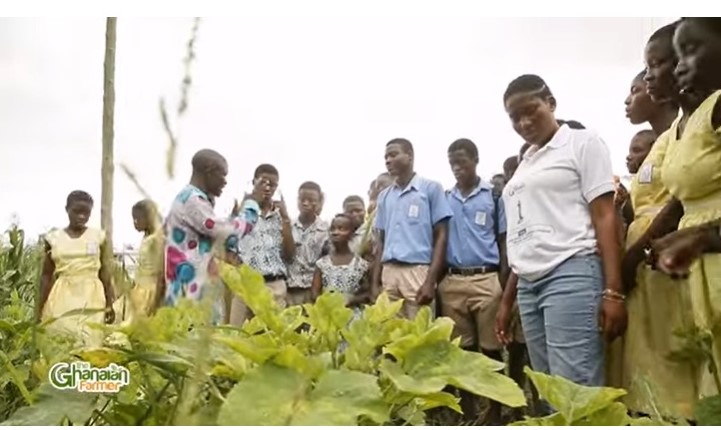
Sekondi College, a Senior High School in the Western Region has defied odds to cushion the government’s efforts in supplying food to the school by engaging in school projects.
Talking to the Ghanaian Farmer TV Show in an interview, the Headmistress of the school Mrs Kermah stated that the school has been known for using its vast land for farming since 2001 but was using the services of prisoners and other labourers. However, the school management has decided actively engage students in farm projects where proceeds from the various crops are used to feed the students while another part is sold to the public.
With a student population of 2864 reading six programmes of which 150 students are studying agricultural science in forms 1, 2 and 3, she disclosed that all the students, both day and boarding work on the farms as it also serves as a learning platform to raise generational modern farmers.
“Farming has been in Sekondi College since 2001 by the late Osei Yeboah where some of the proceeds were used to feed the school. At the time prisoners were employed to work on the farm but currently, students are actively involved. They were bringing in prisoners and other people and they were paying them.”
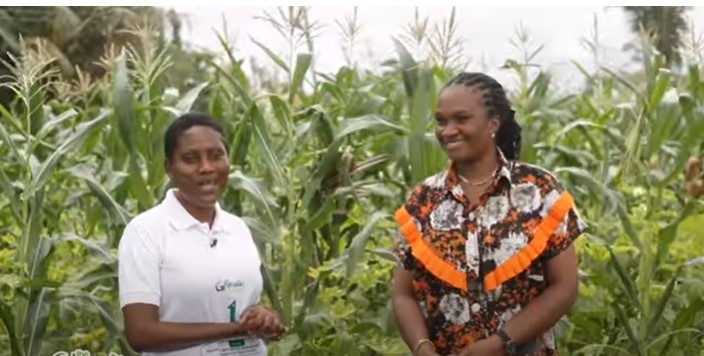
“But looking at the free SHS and looking at the funds for feeding students and others, we decided to initiate that project of one student, one plant and for us to achieve such a goal, we decided to bring all houses on board so students in the boarding house will have their area of planting,” she told Enyonam Manye, Host of The Ghanaian Farmer TV Show.
Talking about funding, the Headmistress further explained that the school pre-finances the farms and ensures that there’s competition among the students to ensure they nurture the crops well under the supervision of teachers.
“We also have day students farms for boys and girls as a competition. They grow crops such as maize, okro, palm fruit, coconut, piggery and rabbitry as well. There is also a greenhouse where we do vegetables such as pepper, and cucumber and also have a cassava farm of about 2,500 trees.”
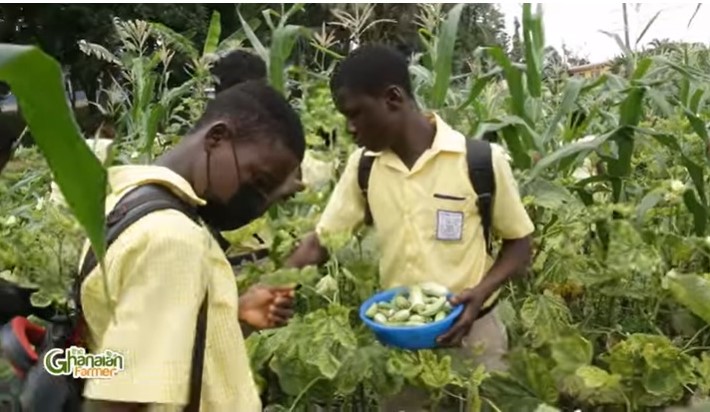
“The school pre-finances the project and because the students participated in everything that we did the teachers also monitored, we ensure that the students also feed on the products. So when we harvested our first okro we sent it to the dining for the students to also enjoy as well as the staff. Each house works on the farm for 30 minutes after school,” Mrs Kermah reiterated.
According to her, aside from the initiative serving as support for feeding the students, it also creates a platform where the students will graduate with basic on-field practical skills in crop production.
“We want all students to understand that there is a need for them to also learn how to plant; it shouldn’t be about I’m a science or business student and that is all.”
“As our vision states, holistic education for nation building, because of that we want all students to be on board so that they leave school and go and be able to do something not entirely depending on their parents for funding. Some of our old students are into farming and this is helping them in their tertiary education.”
She used the opportunity to encourage other schools across the country to adopt this strategy to help augment the state’s expenditure on feeding. Besides, it will go a long way to train to have knowledge in basic agricultural practices.
“So other schools that have pieces of land, bring the students on board and train to learn how to do planting so such students will go home and practice what has been taught on the school so we’re educating students holistically not only on the academic ground.”
FEEDBACK FROM STUDENTS
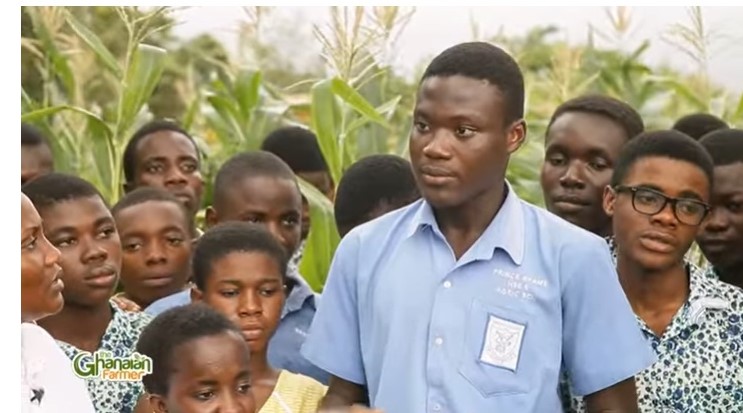
Meanwhile, the Ghanaian Farmer TV show engaged some students who shared their thoughts about the Sekondi College school farm project.
Joycelyn, a Prefect of Sekondi College and an agric student said “I feel good about this. First of all, I didn’t know anything about agric when I came but through the practical aspects of the course, I can now plant crops on my own. Mostly, the weeding aspect is not much. We usually do planting under the supervision of our teachers.”
Another third-year student while sharing his experience with the Ghanaian Farmer TV show said he learnt a lot including planting, fertilizer application and mulching.
