

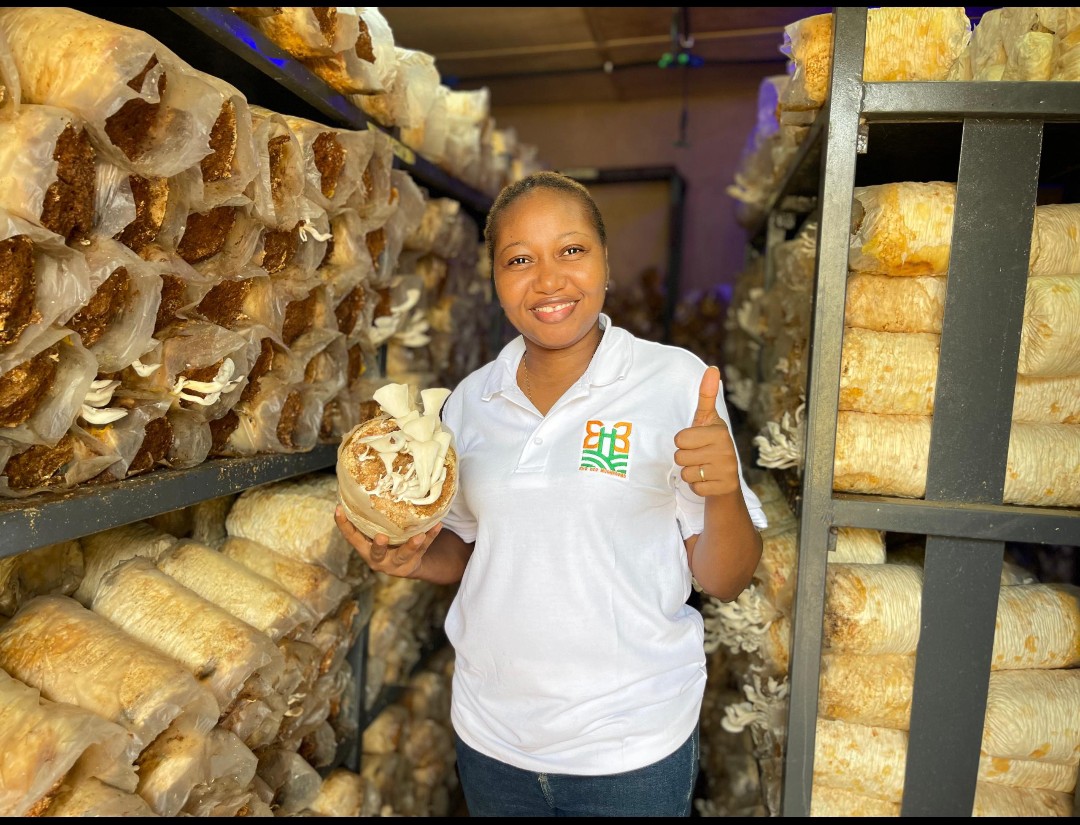
In the serene hills of Aburi, in the eastern region of Ghana, lies the story of a remarkable woman and her mushroom farm, EHB Eco Mushrooms.
What began as a simple pastime hobby, has transformed a humble backyard hobby into a cutting-edge farm in Ghana, blending modern technology with sustainable practices to revolutionize mushroom farming.
With over half a decade of experience in Human Resources Management, Priscilla Eyram Morny, the co-founder of EHB Eco mushrooms wasn’t originally drawn to farming. She was just following her father’s footsteps; venturing into mushroom farming as a hobby, an escape from the corporate world.
However, after years of research, she discovered the art of mushroom cultivation and saw it as a way to contribute to her community and the environment.
Priscilla’s farm, nestled in the mountains of Aburi in the eastern region is nothing short of simple but effective. She uses a climate-controlled system, carefully monitoring humidity, temperature, and ventilation, using sensors to ensure everything is just right for the mushrooms to thrive.
Her substrates are made from local ingredients like sawdust, wheat bran, and rice bran, mixed with moringa powder for added nutrition. This approach not only reduced costs but also ensured her mushrooms were as healthy as possible.
Speaking to the Ghanaian Farmer during the team’s visit to her cropping houses, Madam Priscilla said she harvests “25kg and 50kg of mushrooms a day”, which she sells and distributes to local hotels, restaurants, and markets.
She also indicated that she faced some difficulties when she decided to move her farm from her father’s backyard to her present location when she decided to go commercial.
“I faced some challenges, which included access to finance. Even though I had some financial support from my partners, I still needed more. I also suffered from imposter syndrome. I felt like I wasn’t good enough or I wasn’t doing much, even though, in reality, that’s not the case. I was always afraid, and it mostly felt like I was living a lie”, she stated.
Despite it all, she remained passionate about her work. She believes that mushrooms could be a sustainable food source and a way to bring people together.
Priscilla often shares her knowledge with other farmers, emphasising the importance of perseverance, passion, and building a supportive community.
She understands the value of hard work and the joy of seeing her mushrooms grow from tiny spores into something bigger. It wasn’t just about the mushrooms—it was about the connection between people, nature, and the food they shared, and that was evident when the Ghanaian Farmer team visited her farm and witnessed the bond she shared with her employees, whom she’s been with for the past 8 years.
In her concluding remarks, Madam Priscilla advised against absentee farming, emphasising the importance of being present and involved to enhance transparency, record keeping and maximising profits.
“I will always advise that people who wish to be in the farming business must be present right from the beginning. It is important because not being present may encourage indifference from those who may be hired to do the work. They may decide to rip you off of your profits, or even collapse the business”, she said.
Mushrooms are indeed, a reminder that, sometimes, growth can happen in the shadows.
Reporting by Stephen Freeman, Accra.
